
When hiring a plumber, you’ll typically choose between flat-rate pricing or hourly billing. Each has its pros and cons, and the best option depends on the job and your priorities.
- Flat-rate pricing offers a fixed cost upfront, covering labor, materials, and overhead. It’s great for predictable jobs like installations or large repairs, as you’ll know the total cost before work begins. However, it may be pricier for quick, simple tasks.
- Hourly pricing charges based on the time worked and materials used. It’s ideal for smaller or uncertain jobs, but costs can rise if the work takes longer than expected.
Quick Comparison
| Feature | Flat-Rate Pricing | Hourly Pricing |
|---|---|---|
| Budget Certainty | High; fixed upfront price | Low; cost depends on time |
| Cost Transparency | Low; bundled costs | High; itemized breakdown |
| Risk | Plumber assumes risk | Homeowner assumes risk |
| Best For | Standard installs, big jobs | Small fixes, diagnostics |
Flat-rate pricing works well for homeowners who want cost certainty, while hourly billing suits those comfortable with potential fluctuations for smaller or exploratory tasks. Choose based on the scope and complexity of your plumbing needs.
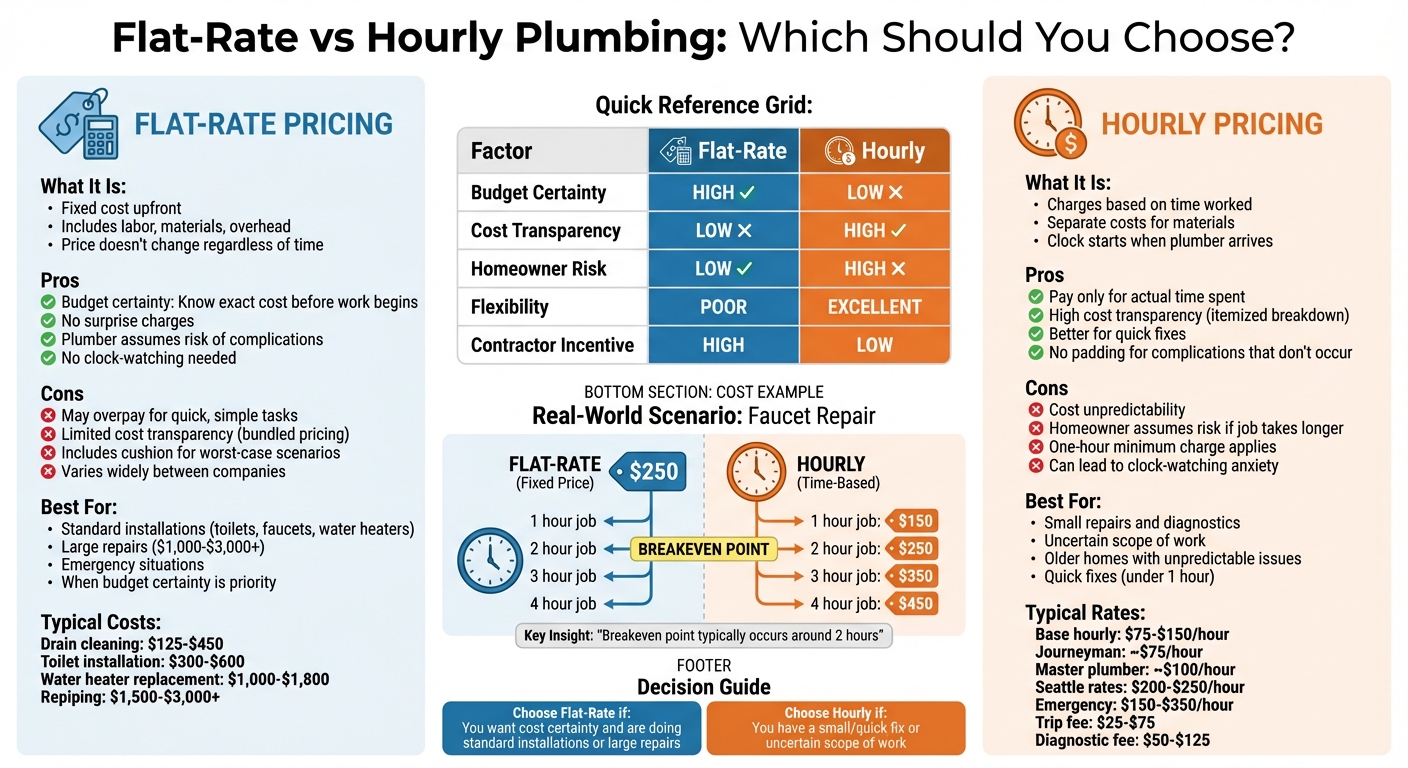
Flat-Rate vs Hourly Plumbing Pricing Comparison Guide
Flat Rate vs. Hourly: The ULTIMATE Pricing Comparison
sbb-itb-6ceaf48
What Is Flat-Rate Pricing?
Flat-rate pricing is a system where a plumber provides a fixed cost for an entire job upfront. This price includes everything - labor, parts, and overhead expenses like insurance, fuel, and licensing fees - all bundled into one number. Once you agree to the quote, that price doesn’t change, no matter if the repair takes 20 minutes or several hours.
To determine these fixed prices, plumbers rely on historical data stored in pricing books. For example, when you call about a clogged drain or a leaky faucet, the plumber can quickly reference the book and give you an immediate quote.
Unlike hourly billing, you’re not keeping track of how long the job takes. If unexpected complications arise or the work takes longer than anticipated, the plumber absorbs that risk. This approach ensures you won’t face surprise charges, providing peace of mind about the final cost. Now, let’s dive into why this method appeals to so many homeowners.
Pros of Flat-Rate Pricing
You know exactly what you’ll pay before the work begins. This eliminates the stress of wondering if the plumber is dragging their feet or if unforeseen problems will double your bill. For common repairs like drain cleaning (typically $125–$450) or toilet installation (around $300–$600), you can compare quotes and make an informed choice.
Flat-rate pricing is particularly useful for large projects where unexpected issues could inflate an hourly bill. For instance, a water heater replacement might have a flat rate of $1,000–$1,800. In contrast, if billed hourly at $200 per hour, complications could make the job much more expensive. With a flat rate, those risks are the plumber’s responsibility, not yours.
Budgeting becomes straightforward. You can prioritize repairs based on fixed costs and plan your spending without worrying about unexpected price hikes. As John Shelton Plumbing explains:
Flat rate plumbing pricing removes that uncertainty by providing an upfront cost before work begins - so there are no surprises unless something truly unusual happens.
Another benefit? No clock-watching. You don’t need to monitor the plumber’s pace or worry about delays adding to your bill. For plumbers, this system encourages efficiency, allowing them to complete more jobs in a day while you enjoy predictable pricing.
Cons of Flat-Rate Pricing
Flat-rate pricing often includes a cushion for worst-case scenarios. If your repair is straightforward and takes just 15 minutes, you’ll still pay the full flat rate, which might be much higher than what an hourly plumber would charge for such a quick fix.
For simple tasks - like tightening a loose fitting or replacing a washer - an hourly rate with a one-hour minimum could save you money. Essentially, with flat-rate pricing, you’re paying for insurance against complications that might not even happen.
Another drawback is limited transparency. Unlike hourly billing, where you can see a detailed breakdown of labor and materials, flat-rate pricing bundles everything together. This lack of itemization can make it harder to understand exactly what you’re paying for.
Lastly, flat rates can vary widely between companies, influenced by their overhead costs and profit margins. Plumbing businesses typically aim for a profit margin of 10%–30% per job. Without an itemized breakdown, it’s tough to gauge whether you’re getting a fair price.
What Is Hourly Pricing?
Hourly pricing, often referred to as Time and Materials (T&M), charges based on the time spent working and includes separate costs for materials. The clock starts ticking when the plumber arrives and stops when they leave your property.
This pricing model typically involves a base hourly rate ranging from $75 to $150, with a minimum charge of at least one hour. Additional charges include itemized costs for materials, trip fees, and diagnostics. For example, trip fees - usually $25 to $75 - cover travel and fuel, while diagnostic fees - ranging from $50 to $125 - are for identifying the issue. Some companies may credit the diagnostic fee toward the final bill if you proceed with the repair. Emergency or after-hours work can significantly increase costs, with hourly rates climbing to $150–$350.
Unlike flat-rate pricing, which bundles all costs together, hourly pricing provides a detailed breakdown. You'll see exactly how many hours were worked, the materials used, and their respective costs. This transparency helps you understand where your money is going.
Pros of Hourly Pricing
Hourly pricing is ideal for smaller, straightforward tasks where you're paying strictly for the time spent, potentially avoiding the higher costs of a flat rate. Arvin from Prestige Plumbing explains:
Hourly rates work well when jobs are small or uncertain. If the plumber only needs 30 minutes, you're not overpaying.
Additionally, hourly billing can allow for a more measured approach to the work. SharkBite highlights this advantage:
With hourly rates, your team may feel less pressure to race against the clock, which can allow them to focus on a job well done and minimize installation errors from rushing.
Cons of Hourly Pricing
However, hourly pricing comes with its challenges, particularly cost unpredictability. Unlike flat-rate pricing, you won't know the total cost until the job is completed, which can make budgeting difficult. Unexpected issues, such as corroded pipes or hidden leaks, can drive up the final bill significantly.
This uncertainty can also lead to time pressure for homeowners, who may find themselves closely watching the clock, wondering if the plumber is working efficiently. Cameron Brown from ServiceTitan explains:
With Time & Materials pricing, plumbing techs who work slowly... can run up the bill, even if they're doing an inadequate job.
Another downside is the one-hour minimum charge. Even if a repair takes just 15 minutes, you’re still billed for the full hour, plus any service fees. This could leave you paying $125 to $225 for a quick fix. Additionally, if the job encounters unexpected delays - like hard-to-reach pipes or hidden complications - you bear the financial burden of extended labor.
Flat-Rate vs Hourly Pricing: Side-by-Side Comparison
When deciding between flat-rate and hourly pricing, it all boils down to two key factors: who takes on the financial risk and whether you prioritize budget predictability or cost clarity.
Flat-rate pricing gives you peace of mind with a set price upfront. You’ll know exactly what you’re paying, but it comes at the cost of transparency since labor and materials are rolled into one figure. As one expert puts it:
Flat-rate pricing feels clean and safe - but in plumbing's messy world of hidden variables, rigid quotes often cost you more than they save you.
On the flip side, hourly pricing offers detailed breakdowns of hours worked and materials used. While this provides a clearer picture of where your money goes, it also shifts the risk to you - unexpected complications can mean higher costs.
Comparison Table: Key Differences
| Feature | Flat-Rate Pricing | Hourly (Time & Materials) |
|---|---|---|
| Budget Certainty | High; price is fixed upfront | Low; final cost unknown until completion |
| Cost Transparency | Low; labor and parts bundled | High; itemized hours and materials |
| Homeowner Risk | Low; no extra charge for delays | High; costs can rise if the job takes longer |
| Contractor Incentive | High; encourages efficient work | Low; no financial incentive for speed |
| Flexibility | Poor; requires new quotes for scope changes | Excellent; adapts in real time to discoveries |
| Best Use Case | Standardized installs and major repairs | Minor fixes and diagnostic work |
When Flat-Rate Pricing Works Best
Flat-rate pricing shines in situations where jobs are routine and outcomes are predictable. Take standard installations, for example: water heater replacements typically range from $1,000–$1,800, toilet installations fall between $300–$600, and faucet replacements cost around $250–$450. These tasks follow well-defined steps, making it easy to estimate both time and materials needed.
This pricing model is also a safeguard during more complicated projects that might involve hidden surprises. Think about a repiping job ($1,500–$3,000+) or tracing a mysterious leak behind a wall. Flat-rate pricing ensures you’re not hit with unexpected costs if unforeseen complications arise. Services like drain and sewer work also benefit from this system, as it provides consistent pricing no matter how long the job takes. This level of predictability is especially helpful when you're juggling a tight budget or dealing with an urgent repair.
Flat-rate pricing is particularly useful when cost certainty is a must - especially for emergencies, where hourly rates can skyrocket to 1.5x or even 2x the standard rate.
In West Seattle, this approach is a game-changer. Companies like Sasquatch Plumbing Services Seattle offer upfront flat-rate pricing for services like water heater installations, repiping, and drain cleaning. This means you’ll know exactly what you’re paying before the work even begins.
When Hourly Pricing Works Best
Hourly pricing shines in situations where the scope of work is uncertain or unpredictable. For example, if you're dealing with a mysterious wall leak or troubleshooting unresponsive backups, paying by the hour ensures you're only charged for the actual time spent diagnosing and solving the issue.
"Hourly pricing for residential plumbing services better allows you to be nimble in case of surprises or if things don't go according to plan." - SharkBite
This model is particularly useful for older homes with fragile plumbing systems. Aging pipes or corroded fittings can turn what seems like a straightforward job - like replacing a valve - into something more complex if brittle pipes break during the process. Hourly rates for plumbing typically fall between $75 and $150 per hour, depending on the plumber's experience. For instance, journeyman plumbers average around $75 per hour, while master plumbers usually charge closer to $100 per hour. In cities like Seattle, rates can climb to $200–$250 per hour.
Another advantage of hourly pricing is that it avoids the "worst-case scenario padding" often built into flat-rate quotes. Flat-rate pricing includes a financial cushion to cover potential complications, but with hourly billing, you only pay for the time actually spent on the job. This can be especially cost-effective for quick tasks like tightening a fitting, replacing a single valve, or cleaning a P-trap - jobs that might take less than an hour. In these cases, an hourly rate could save you money compared to a flat fee designed for more complex work.
To protect your budget while benefiting from hourly pricing, consider requesting a "Not-to-Exceed" (NTE) clause. This sets a maximum cap on the total cost, giving you peace of mind. Also, check if the plumber has a one-hour minimum charge or a trip fee, which typically ranges from $25 to $75. These steps let you enjoy the flexibility of hourly pricing while keeping unexpected expenses in check.
Cost Examples: Flat-Rate vs Hourly
Let’s break down two plumbing scenarios to see how different pricing models - flat-rate and hourly - impact your total bill depending on how long the job takes.
For instance, imagine a faucet repair. If a plumber charges $100 per hour with a $150 service fee (which covers the first hour), the cost for a one-hour job would be $150. Compare that to a flat-rate quote of $250, and the flat-rate option is $100 more expensive. However, if the repair takes three hours due to complications, the hourly model would cost $350, while the flat rate would still be $250. In this case, the flat rate saves you $100.
Now, consider a standard repair. With an average hourly rate of $125 and a $75 trip fee, a one-hour job totals $200 under the hourly model, compared to a flat rate of $350. But if the repair stretches to four hours, the hourly cost becomes $575 ($125 per hour plus the $75 trip fee), which is $225 more than the flat-rate price of $350.
Here’s how common repairs compare:
- Minor Leak Repairs: Hourly rates typically range from $125 to $200, while flat-rate pricing falls between $150 and $275.
- Faucet Installations: Hourly costs usually run from $200 to $400, compared to $250 to $450 for flat-rate quotes.
- Drain Cleaning: By the hour, you’re looking at $175 to $350, while flat-rate pricing ranges from $250 to $450.
To make these differences even clearer, take a look at the table below:
Cost Comparison Table: Different Time Scenarios
| Time Spent | Hourly Pricing Total ($100/hr + $150 service fee) | Flat-Rate Pricing Total |
|---|---|---|
| 1 Hour | $150 | $250 |
| 2 Hours | $250 | $250 |
| 3 Hours | $350 | $250 |
| 4 Hours | $450 | $250 |
The key takeaway? The breakeven point often happens around the two-hour mark. Shorter jobs tend to be cheaper with hourly pricing, while longer ones benefit from the predictability of a flat rate.
Sasquatch Plumbing Services Seattle: Upfront Flat-Rate Pricing
When you choose Sasquatch Plumbing Services Seattle, there’s no guessing game when it comes to costs. Their upfront flat-rate pricing ensures you know exactly what you’ll pay before any work begins. This written estimate includes everything - materials, labor, and even travel time - so there are no surprises.
This approach is especially helpful in the fast-paced environment of West Seattle. Whether it’s a burst pipe or a backed-up sewer line that needs immediate attention, their flat-rate pricing locks in the cost at the start. Even if the repair turns out to be more complicated than expected, the price stays the same. That means the plumber takes on the risk of extra work - not you.
"With flat-rate pricing, customers know exactly what a job will cost, regardless of its duration." - ServiceTitan
Sasquatch Plumbing goes beyond transparent pricing by offering a satisfaction guarantee, ensuring every job meets high-quality standards. Their team of licensed plumbers serves all neighborhoods in West Seattle, providing services like drain cleaning, water heater repair and installation, repiping, and plumbing for remodels. This commitment to clear, all-inclusive pricing highlights why flat-rate billing is such a smart choice for homeowners.
With straightforward costs, quick service, and guaranteed quality, flat-rate pricing offers West Seattle homeowners peace of mind and a complete, reliable solution.
Conclusion: Choosing the Right Pricing Model
Deciding between flat-rate and hourly pricing comes down to the nature of the job, its predictability, and how comfortable you are with potential cost fluctuations. For straightforward tasks like toilet installations or water heater replacements, a flat rate offers clarity, with the plumber shouldering any unexpected expenses.
However, not all repairs fit neatly into a fixed-price framework. Hourly pricing is often better suited for smaller fixes or situations requiring diagnosis. That said, longer jobs can lead to higher bills. As of 2026, hourly rates generally range from $80 to $130, with emergency services climbing to $150–$300 per hour. Knowing these options allows you to choose the pricing model that best matches your repair needs.
For many West Seattle homeowners, flat-rate pricing is the go-to choice. It removes the worry of watching the clock and avoids surprise charges - especially important during emergencies like burst pipes or sewer backups.
Sasquatch Plumbing Services Seattle offers upfront flat-rate pricing that includes materials, labor, and travel time. This approach ensures consistent costs, whether you need a quick fix or a more involved project like repiping. With this transparent pricing, you can protect your budget and handle repairs with confidence.
FAQs
What should I ask a plumber before choosing flat-rate or hourly pricing?
Before making a decision, it’s important to understand how the pricing works. Ask about what’s included in the cost and whether there could be extra charges for unexpected situations. If the service offers flat-rate pricing, check if they provide written estimates before starting the work. For hourly rates, make sure to ask how they track and bill labor hours, and whether there are minimum charges or travel fees. These details can help you make an informed choice that fits both your project needs and your budget.
Can I get a cost cap with hourly billing?
When hiring a plumber, some may agree to a cost cap alongside hourly billing, but this depends on your arrangement. They might offer a written estimate or set a maximum limit to help you avoid surprises. However, not all plumbers include this option, so it's crucial to discuss it upfront. Always confirm whether a cost cap is explicitly part of your agreement to ensure there are no unexpected charges.
Do flat-rate quotes include parts, travel, and permits?
Flat-rate quotes usually bundle together parts, travel, and permits into a single upfront price. This approach provides clarity and helps customers steer clear of surprise fees down the line.