
Hidden leaks can cause major damage to your home if left untreated. Knowing whether to handle repairs yourself or call a professional can save you time, money, and stress. Here's a quick breakdown:
- DIY Repairs: Best for simple, visible leaks like dripping faucets or loose fittings. Costs are low, often under $50 for materials like Teflon tape or washers. However, DIY fixes can fail, especially for hidden leaks, leading to bigger issues like mold or water damage.
- Professional Services: Ideal for concealed or complex leaks. Plumbers use advanced tools like thermal imaging and acoustic sensors to locate problems without unnecessary damage. Costs start around $150–$200 for detection, with repairs ranging from $150 to $5,000 depending on the severity.
Key Takeaway: DIY is fine for minor issues, but hidden leaks often require professional expertise to avoid costly mistakes. For areas like West Seattle, where aging pipes and shifting soil are common, hiring a local plumber ensures accurate repairs and long-term solutions.
DIY Methods for Finding and Fixing Hidden Leaks
Simple Detection Methods
Start with your water meter. Shut off all faucets and appliances, note the meter reading, and check it again after 30–60 minutes. If the numbers change, you’ve got a leak. To figure out if the problem is inside or outside, close the main shut-off valve. If the meter keeps moving, the leak is in the buried line between the meter and your house. If it stops, the issue is inside.
The toilet dye test is another quick trick for spotting silent leaks. Drop some food coloring or a dye tablet into the tank and wait 10–30 minutes without flushing. If the color shows up in the bowl, the flapper valve needs replacing. For tiny leaks under sinks, wipe connections with a dry tissue - if it gets damp, you’ve found the culprit. Got older metal pipes? Use a screwdriver or stethoscope to listen for hissing or rushing water while all fixtures are off.
Keep an eye out for visual signs of hidden leaks. Stains on walls or ceilings, bubbling paint, warped floors, or musty smells can all point to water damage. Outside, unusually green or fast-growing patches of grass may signal an underground leak in the supply line.
These straightforward techniques can help you identify leaks quickly, setting the stage for either DIY repairs or professional help.
DIY Repair Tools and Methods
Once you’ve found the leak, a few basic tools and materials can handle smaller fixes. Adjustable wrenches, pliers, multi-screwdrivers, knives, and caulk guns are staples for simple repairs. Materials like silicone caulk, gaskets, washers, O-rings, wax rings, and Teflon joint compound are easy to find at hardware stores. Replacing a wax ring, faucet washer, or toilet flapper often costs under $20 in materials.
For visible leaks, try tightening loose fittings, swapping out worn washers, or using silicone repair tape for a temporary fix. A dripping shutoff valve? Tighten the packing nut with a wrench - it’s a quick and effective solution. For pipe joint leaks, Teflon joint compound or repair epoxy can seal the issue for the short term.
While these fixes work for minor and accessible leaks, they’re less effective for hidden or complex problems.
Problems and Limits of DIY Repairs
DIY methods shine for simple, visible leaks but fall short when dealing with concealed issues behind walls, under floors, or in concrete slabs. Professionals use advanced tools like acoustic sensors, thermal imaging cameras, and infrared moisture meters to locate hidden leaks without causing unnecessary damage. Attempting to fix such leaks without the right tools or expertise can backfire. Over-tightening fittings or using the wrong sealant might crack pipes or worsen the problem, potentially leading to severe flooding.
Most DIY repairs are temporary fixes. For example, repair tape or epoxy can stop a drip but won’t address underlying issues like corroded pipes or high water pressure. Ignoring these causes can lead to bigger problems, like rotting subfloors, warped plywood, or mold growth, which can start within 24–48 hours of water exposure. In cities like Seattle, major water line repairs often require permits, and unpermitted DIY fixes could become a liability when selling your home or filing insurance claims.
"The $200 you spend on a proper inspection beats the $2,000 you'll spend fixing everything you broke trying to find it yourself."
- Frank Gaborik, Owner, Danika Plumbing
If simple tests and visual inspections don’t reveal the source of the leak quickly, it’s time to call in a professional. They have the expertise and tools to handle the problem with precision, protecting your home from further damage and saving you money in the long run.
Professional Detection and Repair Services
Advanced Leak Detection Equipment
When it comes to finding leaks, professional plumbers rely on cutting-edge tools to get the job done without tearing up your home. Tools like thermal imaging cameras can spot temperature changes caused by moisture, identifying damp areas without the need for demolition. Acoustic devices are another game-changer - they amplify the sound of water escaping through walls, soil, or concrete, making it easier to locate the source of the leak. As Reliant Plumbing puts it, "When you can hear exactly where the leak is happening, you avoid unnecessary demolition and dramatically reduce repair costs."
For a closer look, endoscopic cameras provide real-time visuals inside pipes, helping to identify cracks, corrosion, or even roots invading the system. Moisture meters measure water levels in materials like drywall and wood, often catching leaks before stains appear. For underground issues, soil probes track changes in sound velocity to detect leaks in buried pipes. Pressure testing is another key method, isolating the affected section of the plumbing system to zero in on the problem. However, the advanced, professional-grade equipment used for these tasks can cost hundreds of dollars, making it impractical for DIY attempts.
Once the leak’s location is confirmed, the focus shifts to implementing a lasting fix.
Complete Repair Solutions
After pinpointing the problem, professional plumbers don’t just patch things up - they tackle the root causes to ensure the issue doesn’t return. Whether the problem stems from excessive water pressure, corroded pipes, or even shifting foundations, licensed technicians address it all. They use durable materials like PEX or copper and strictly follow Seattle building codes. This attention to detail is essential for maintaining your home’s value and meeting insurance requirements.
For leaks hidden beneath concrete slabs or underground, trenchless technology offers a minimally invasive solution. Techniques like cured-in-place pipe lining repair damaged sections without the need for disruptive digging. Once repairs are complete, plumbers perform system-wide pressure tests to confirm that the entire plumbing system is in good shape.
Why Choose Professional Services
Hiring a licensed plumber comes with benefits that DIY fixes simply can’t match. They carry insurance, offer satisfaction guarantees, and provide warranties on their work. In areas like West Seattle, where shifting soil and heavy rainfall can accelerate pipe corrosion, local expertise is especially important. For example, Sasquatch Plumbing Services Seattle specializes in leak detection and repair throughout West Seattle neighborhoods. They offer same-day emergency services, upfront pricing, and a satisfaction guarantee. Their technicians are well-versed in the area’s challenges, from soil movement to aging infrastructure.
For most homeowners, professional leak detection typically costs between $170 and $200, with minor repairs ranging from $150 to $600. While that might seem like an expense, it’s a fraction of the potential $2,000 or more you could face if a DIY fix goes wrong. In the long run, professional services save both time and money while ensuring peace of mind.
THIS Is How PLUMBERS Do Leak Detection!
sbb-itb-6ceaf48
Cost Comparison: DIY vs. Professional Repairs
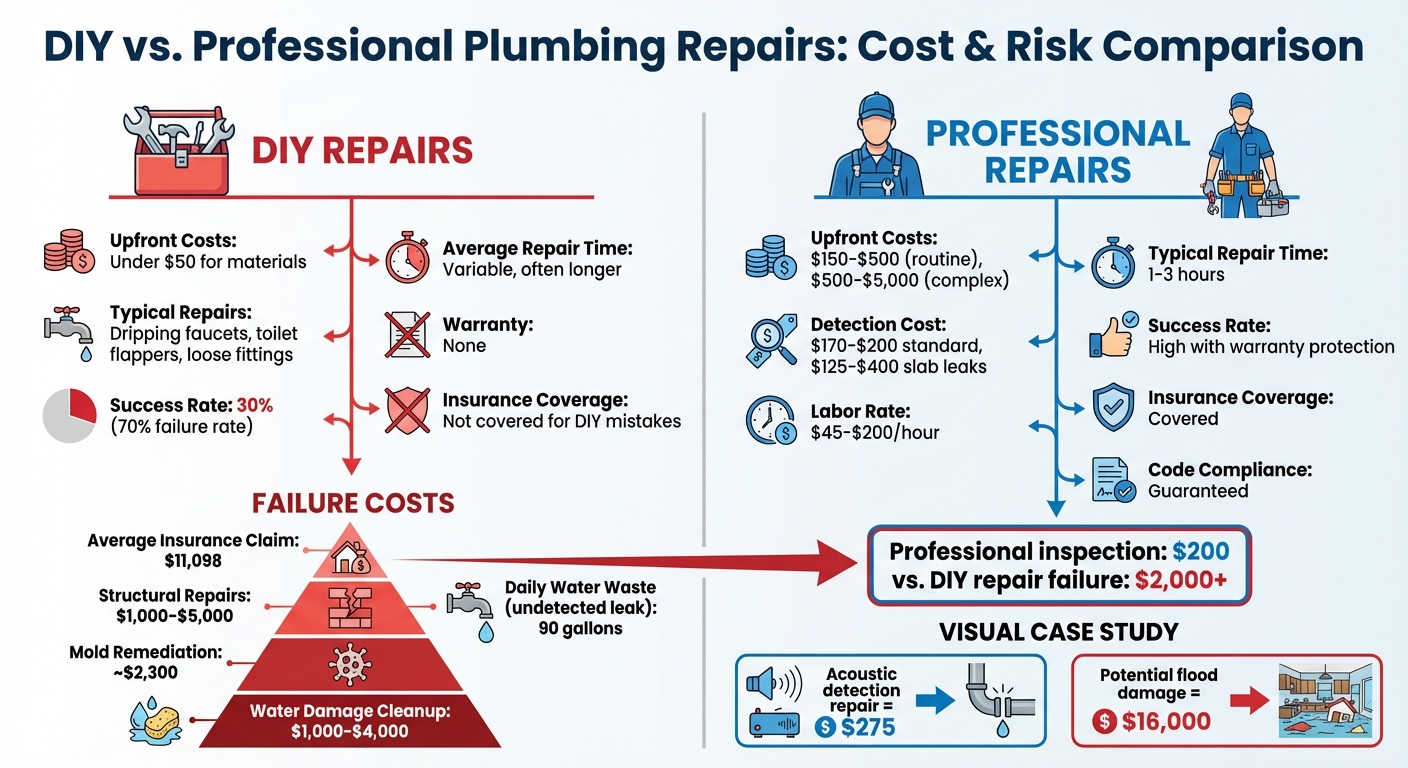
DIY vs Professional Plumbing Repair Costs and Success Rates Comparison
Upfront Costs
DIY repairs might look like a bargain at first glance. You can often grab basic materials like plumber's tape, epoxy putty, or washers for under $50. It feels simple enough - fix the leak and move on.
On the other hand, professional repairs come with a notable starting cost. Service fees typically range from $50 to $200, with routine fixes falling between $150 and $500. For more complex issues, like hidden or slab leaks, costs can skyrocket to $500–$5,000 or more. Labor charges alone can range from $45 to $200 per hour. For diagnostics, expect to pay around $80–$100 for standard leak detection, while pinpointing a slab leak might cost anywhere from $125 to $400.
But here’s the catch: those initial DIY savings can quickly disappear if the fix doesn’t hold, often leading to much higher repair bills down the line.
Long-Term Costs and Risks
While upfront costs are easy to compare, the bigger picture reveals the potential risks of DIY repairs. Nearly 70% of DIY plumbing fixes fail, often creating issues worse than the original leak. A failed repair can lead to a burst pipe, with water damage cleanup and restoration costs averaging between $1,000 and $4,000. Tack on mold remediation, which typically costs around $2,300, or structural repairs for rotted floor joists, which can run anywhere from $1,000 to $5,000, and the expenses quickly spiral.
"DIY repairs can save money upfront... However, without proper experience, you risk worsening the leak or causing water damage inside your walls."
– James Ratliff, Right Solution Plumbing
Insurance is another critical factor. Most homeowner's policies don’t cover water damage caused by DIY mistakes. With the average water damage claim costing around $11,098, the stakes are high. In contrast, professional plumbers often provide warranties or guarantees, offering peace of mind and protection against recurring problems. They also ensure the work meets building codes, which is crucial if you’re planning to sell your home. Non-compliant DIY repairs can lower your property’s value or even derail a sale.
Here’s a real-world example: In November 2025, a Reliant Plumbing specialist used acoustic equipment to locate a failing water line at a lake house. Thanks to their precision, the homeowner only had to replace a small section of PEX pipe, avoiding the need to break concrete or relocate the entire line. This targeted repair cost $275, compared to the potential $16,000 expense for flood cleanup and structural repairs. It’s a clear reminder that professional expertise often prevents costly mistakes, protecting your home and wallet in the long run.
When to Call a Professional Plumber
Situations That Need Professional Help
While some leaks can be managed with DIY fixes, others require the expertise of a professional. For instance, leaks hidden behind walls or under slabs are nearly impossible to address without specialized tools. Clues like warm spots on floors, damp carpets, or the sound of water running consistently are strong indicators that professional diagnostic equipment is necessary to locate the problem safely and accurately. Acting quickly in these cases can prevent extensive damage and skyrocketing repair costs.
If a leak is near gas lines, electrical systems, light fixtures, or vents, it’s crucial to shut off the main water valve and call a plumber immediately. These situations pose serious safety risks and should never be handled without professional assistance.
Persistent leaks can also lead to structural damage and health hazards. Signs like mold growth, musty odors, sagging drywall, or rotting wood signal the need for expert help. Mold, for example, can begin forming within just 24–48 hours. Issues with the main water line are another red flag. Pooling water in your yard, rusty or dirty tap water, or an unexpected 20% spike in your water bill often point to a problem in the line between your meter and your house. In cities like Seattle, homeowners are responsible for this section. Attempting to fix it without the right tools can result in catastrophic flooding.
"The $200 you spend on a proper inspection beats the $2,000 you'll spend fixing everything you broke trying to find it yourself."
– Frank Gaborik, Seattle Plumbing Expert
If you suspect a leak but can’t pinpoint its source, it’s best to rely on professional diagnostic tools. Guesswork often leads to unnecessary damage and inflated repair bills. Even a minor, undetected leak can waste up to 90 gallons of water each day. One homeowner, for instance, returned from vacation to find a $3,000 water bill due to an unnoticed leak.
Local Expertise in West Seattle: Sasquatch Plumbing Services Seattle

West Seattle homes come with their own set of plumbing challenges. Many properties still have aging galvanized or copper pipes installed between the 1940s and 1970s. Combined with high groundwater levels and seismic activity, these aging systems are under constant stress. Sasquatch Plumbing Services Seattle is well-equipped to handle these unique issues. Their team uses advanced diagnostic tools to locate leaks precisely, avoiding unnecessary demolition. This allows for targeted "spot repairs", where only the damaged section is replaced, saving both time and money.
Sasquatch Plumbing Services Seattle also offers same-day emergency services, complete with upfront pricing and a satisfaction guarantee. This ensures that West Seattle residents receive reliable, transparent service when they need it most. Whether it’s a hidden slab leak, a failing main water line, or plumbing work for a remodel, their local knowledge and expertise make them the go-to choice. When it comes to complex leak detection and repair, professional help not only safeguards your home but also saves you from costly mistakes in the long run.
Conclusion
Choosing between tackling hidden leaks on your own or hiring a professional boils down to two main factors: how complex the issue is and how confident you are in your skills. Straightforward problems like a dripping faucet or a faulty toilet flapper are often manageable for DIY repairs. But when leaks are concealed behind walls, under concrete, or near gas and electrical lines, the stakes get much higher. Without specialized tools like acoustic sensors or thermal imaging cameras, DIY efforts can lack the precision needed, potentially leading to unnecessary demolition or structural damage.
The numbers tell a cautionary tale: around 70% of DIY plumbing attempts fail, and water damage claims average $11,098 per incident. Even a small, undetected leak can waste as much as 90 gallons of water every single day. Professionals not only bring the right tools but also ensure accurate diagnoses, repairs that meet safety codes, and warranties to back their work. While professional repairs typically take 1–3 hours, DIY fixes can drag on much longer and may still fall short.
Considering the high failure rate of DIY attempts and the risks involved, homeowners dealing with the aging plumbing systems in West Seattle face unique challenges. Sasquatch Plumbing Services Seattle offers the expertise and advanced equipment needed to handle even the most complex leaks. With same-day emergency services, upfront pricing, and a satisfaction guarantee, they provide reliable, code-compliant solutions that DIY methods simply can’t match. For intricate leak issues, calling in the pros is the safer and smarter route.
FAQs
What are the signs of a hidden leak, and when should I call a professional?
Hidden leaks can be a challenge to pinpoint, but there are a few red flags to keep an eye on. An unexpected spike in your water bill, lower water pressure, stains on your walls or ceilings, damp areas on your floors, or the sound of water running when all fixtures are off could all indicate a hidden leak. Another clear indicator? If your water meter keeps ticking even after you’ve turned off every water source in your home.
While you might be able to tackle minor leaks with some DIY fixes, hidden leaks are a different story. They usually require specialized tools and expertise to find and repair. For a proper diagnosis and a repair that lasts, it’s wise to bring in a professional plumber. Experts like Sasquatch Plumbing Services Seattle can get the job done efficiently and with precision.
What are the dangers of fixing hidden leaks yourself?
Fixing hidden leaks on your own can easily backfire if you're not careful. These leaks are often tucked away behind walls, under floors, or even in foundations, making it tricky to pinpoint the exact source. Meanwhile, water can continue to seep unnoticed, leading to serious structural problems like warped drywall, rotting wood, or cracked concrete. On top of that, lingering moisture creates the perfect environment for mold and mildew, which can harm your indoor air quality and potentially pose health risks.
Attempting DIY repairs also comes with safety hazards. Cutting into walls without knowing what’s behind them could accidentally damage electrical wiring or gas lines, creating dangers like fire risks or carbon monoxide exposure. Plus, many plumbing repairs need to comply with building codes. Without a licensed plumber, you risk code violations, failed inspections, or even having your insurance deny claims if more damage occurs.
To avoid these headaches, it’s smarter to call in the experts. Sasquatch Plumbing Services Seattle specializes in finding and fixing hidden leaks. They offer same-day emergency service, clear upfront pricing, and a satisfaction guarantee, so you can trust your home is in good hands.
Why is hiring a professional plumber often more cost-effective for fixing hidden leaks?
Professional plumbers bring both expertise and the right tools to tackle hidden or hard-to-reach leaks efficiently. Their ability to pinpoint and fix issues accurately from the start can save you both time and money. Plus, by resolving the problem properly, they help you avoid major water damage, expensive structural repairs, and the frustration of multiple DIY attempts that might not fully solve the issue.
Another advantage of hiring professionals is their ability to spot underlying problems that aren’t immediately visible. While DIY fixes might seem like a cheaper option at first, the risks of errors and the potential for added costs often make professional services a more practical choice for handling complex leaks.