
When faced with plumbing issues, you might wonder: tackle it yourself or call a professional? DIY can save up to 70% on labor costs, but 7 out of 10 DIY attempts fail, and the average water damage claim is $11,098. Hiring a plumber in Seattle costs $150–$200 per hour, plus service fees, but it ensures expertise, warranties, and insurance coverage. DIY may seem cheaper initially, but the cost of tools, permits, and time adds up. Mistakes can lead to higher expenses, code violations, and voided warranties. For complex tasks or emergencies, professionals are the safer, more reliable choice.
Quick Comparison
| Aspect | DIY | Professional |
|---|---|---|
| Cost (Upfront) | Lower (materials/tools: $20–$1,500) | Higher ($150–$200/hr + fees) |
| Time Investment | 15–27+ hours | 1–3 hours |
| Risk of Mistakes | High (70% failure rate) | Low |
| Insurance Coverage | None for DIY errors | Covered by plumber’s policy |
| Warranty | Often voided | Included |
| Emergency Costs | $564–$2,864+ if DIY fails | Standard emergency rates |
DIY is best for minor fixes like replacing washers or unclogging drains. For larger projects, hiring a plumber saves time, reduces risks, and ensures long-term durability.
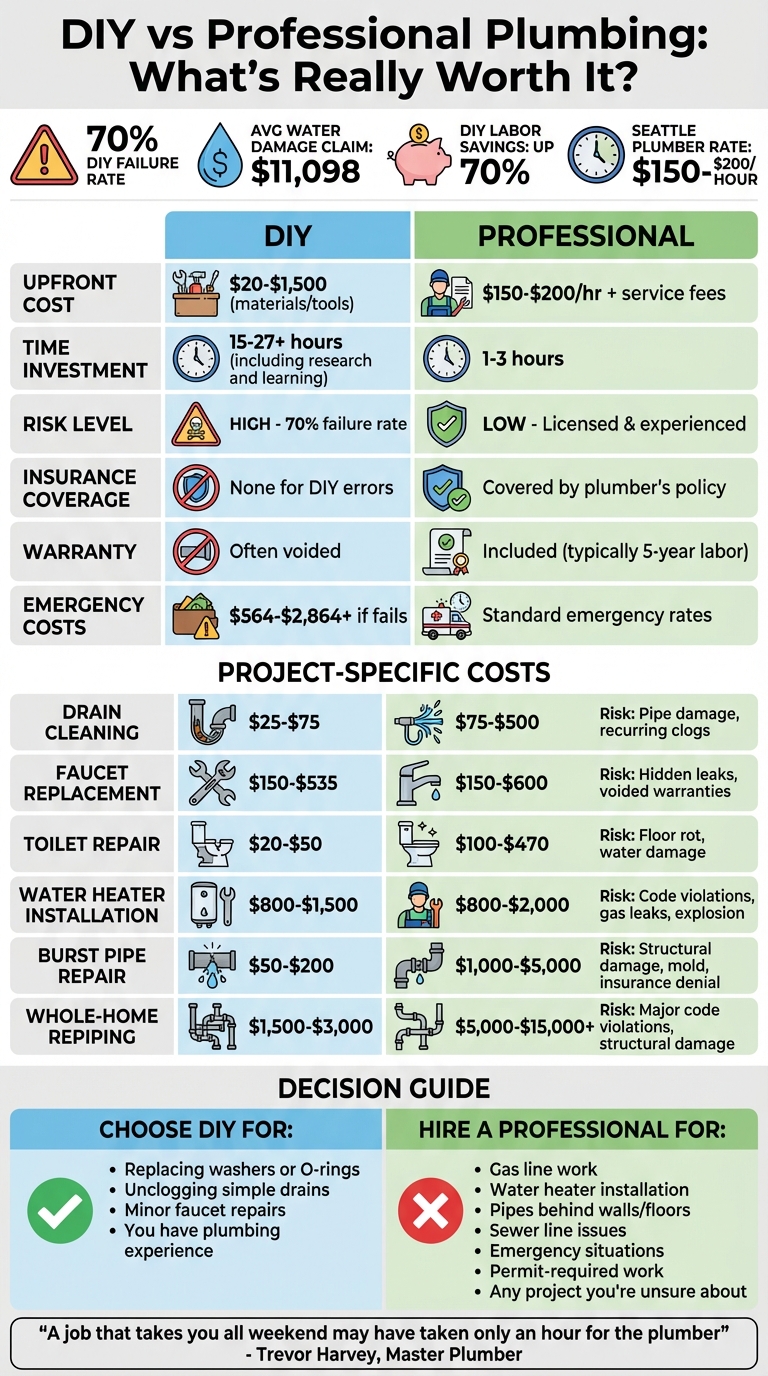
DIY vs Professional Plumbing: Complete Cost and Risk Comparison
DIY or Call a Plumber? 🛠️ Know When to Save Money & When to Call Help
sbb-itb-6ceaf48
DIY Plumbing Costs: Materials, Tools, and Time
DIY plumbing has its perks - most notably skipping hefty labor fees. But don’t overlook the costs of materials, tools, and, most importantly, your time. With labor rates ranging from $45 to $200 per hour, which often make up the bulk of a plumbing bill, taking on the task yourself can seem like a money-saver. However, understanding the full scope of DIY expenses is key to making an informed decision.
Materials: What You’ll Spend on DIY Repairs
For smaller fixes, like stopping a leaky faucet, material costs are pretty low. For example:
- O-rings: $1 to $5
- Rubber washers: $2 to $5
- Replacement cartridges: $10 to $100
If the issue calls for replacing the entire faucet, expect to spend anywhere from $170 to $360 for a mid-range model, while high-end options can exceed $500.
Larger projects, like replacing or rerouting pipes, come with a steeper price tag. Copper pipes, the most expensive option, range from $2 to $12 per linear foot. For a more budget-friendly choice, PEX tubing costs between $0.40 and $4 per foot, while CPVC falls in the middle at $0.50 to $3 per foot. Keep in mind that significant plumbing work may also require permits, which can cost anywhere from $50 to $500. And beyond materials, you’ll need to account for the tools required to get the job done.
Tools: Should You Buy or Rent?
A basic plumbing toolkit, which includes essentials like wrenches and pliers, will set you back about $20 to $50. But for more specialized tools - think basin wrenches, pipe cutters, or augers - you’re looking at an additional $100 to $300. If your project requires professional-grade equipment, such as pipe threaders or inspection cameras, the cost can skyrocket to $500 or even $1,000.
For one-off jobs, renting tools might be the smarter move. For instance, if you rarely need a drain snake or pipe cutter, renting could save you money. Just remember to factor in the time it takes to rent, learn how to use the tool, and return it. While equipment costs are important, don’t underestimate the time investment required for DIY plumbing.
Time Investment: The DIY Learning Curve
DIY plumbing often takes significantly longer than anticipated - sometimes two to three times longer. Before you even start, you might spend 4–8 hours researching the problem, another 3–5 hours watching tutorials, and 2–4 hours learning how to use unfamiliar tools. Meanwhile, a professional plumber, armed with experience and the right tools, can often complete the same repair in just 1 to 3 hours.
Trevor Harvey from Afford-A-Rooter Plumbing explains it best: "A job that takes you all weekend may have taken only an hour for the plumber".
For those in West Seattle balancing work, family, and other responsibilities, the time difference can be a dealbreaker. And if the DIY attempt doesn’t go as planned, you might have to start over - or call in a professional anyway.
Professional Plumbing Costs: Labor, Fees, and Service Rates
When you hire a professional plumber, you're not just paying for the repair itself. You're covering labor, service fees, and the expertise of someone with years of training. Understanding these costs ahead of time can help you avoid unexpected charges.
Hourly Rates and Service Fees
In West Seattle, plumbing rates are influenced by the area's higher living costs and strict building codes. Nationally, plumbers charge between $80 and $130 per hour. However, Seattle rates are steeper, ranging from $150 to $200 per hour for most jobs. For specialized or highly complex tasks, rates can climb as high as $450 per hour.
In addition to hourly rates, many plumbers charge a service fee, typically between $75 and $200. This fee covers travel and initial diagnostics and may be credited toward the repair if you proceed with the work. As master plumber Michael R. Jennings explains:
"In my 18 years as a master plumber, the biggest sticker shock I see is when homeowners don't realize the hourly rate doesn't include the service call fee".
For emergency services - like after-hours, weekend, or holiday calls - expect to pay significantly more. These rates often range from 1.5 to 3 times the standard hourly rate, meaning you could spend $150 to $300 per hour or more. To save money, try to schedule non-urgent repairs during regular weekday hours.
Beyond these fees, the type of project you're tackling will also affect the total cost.
Common Project Costs
Plumbing project costs can vary widely depending on the scope and complexity of the work. Here's what you might expect for common plumbing jobs in Seattle:
| Service Type | Seattle Cost Range | National Average |
|---|---|---|
| Drain Cleaning | $150–$450 | $125–$300 |
| Toilet Installation | $300–$800 | $350–$800 |
| Faucet/Fixture Replacement | $150–$600 | $150–$600 |
| Water Heater Installation | $800–$2,000 | $1,600–$7,000 |
| Burst Pipe Repair | $1,000–$4,000 | $600–$4,500 |
| Whole-Home Repiping | $4,000–$15,000+ | $4,000–$15,000 |
In Seattle, additional costs like permits and inspections can also add up. For work valued over $6,000, permits start at $132, with an extra $26 per fixture. Some major projects, like repiping, may also require inspections costing $264 per hour.
Material costs are another factor. Plumbers often mark up parts by 15%–30% to account for sourcing and warranties.
Benefits of Professional Services
While professional plumbing services come at a cost, they offer long-term value that DIY fixes often can't match. Licensed plumbers carry insurance that protects against damages caused by their work - something most homeowner's policies won't cover for DIY repairs. For example, if a professionally installed pipe leaks, their insurance may cover the resulting damage.
Professionals also use advanced tools like remote video cameras and electronic leak detectors, which can pinpoint issues like slab leaks or sewer blockages without unnecessary demolition. This precision saves time and prevents costly trial-and-error approaches.
Another advantage is warranties. Many professional plumbers offer guarantees on their work, meaning they'll fix any issues that arise within the warranty period at no extra charge. This peace of mind is hard to put a price on. Additionally, Seattle Public Utilities provides rebates for water-efficient upgrades, such as WaterSense-certified toilets and heat pump water heaters, which can help offset initial costs through lower utility bills.
For homeowners in West Seattle, where aging plumbing systems are common, hiring a licensed professional ensures the job is done correctly. Companies like Sasquatch Plumbing Services Seattle provide code-compliant repairs backed by warranties, giving you confidence in the work's quality and durability.
Cost Comparison: DIY vs Professional Plumbing
Choosing between DIY plumbing and hiring a professional often boils down to upfront costs - but there’s more to the story. While tackling plumbing projects yourself might save on labor at first, the costs of tools and materials can quickly eat into those savings. On the other hand, professional plumbers include specialized equipment, like inspection cameras and augers, in their rates - tools that would cost a DIYer significantly more to buy or rent.
The hidden costs of DIY plumbing can be substantial. If a DIY attempt fails, you may need to call in a professional to not only fix the original issue but also repair any additional damage caused during your attempt. This can drive costs up by as much as 40% beyond the initial professional quote, particularly for emergency repairs during weekends.
Insurance is another critical factor. Most homeowner insurance policies won’t cover water damage caused by DIY mistakes. Considering the average water damage claim is $11,098, even minor leaks can turn into costly disasters. By contrast, professional plumbers carry liability insurance and often provide workmanship warranties, offering peace of mind and financial protection.
Comparison Table: Costs and Risks
| Project Type | DIY Cost (Materials/Tools) | Professional Cost (Total) | DIY Risks |
|---|---|---|---|
| Drain Cleaning | $25–$75 | $75–$500 | Pipe damage from improper tool use; recurring clogs |
| Faucet Replacement | $150–$535 | $150–$600 | Leaks behind walls; voided fixture warranties |
| Toilet Repair | $20–$50 | $100–$470 | Improper seal causing floor rot and water damage |
| Water Heater Installation | $800–$1,500 | $800–$2,000 | Code violations; gas leaks; explosion risk; voided warranty |
| Burst Pipe Repair | $50–$200 | $1,000–$5,000 | Structural water damage; mold growth; insurance denial |
| Whole-Home Repiping | $1,500–$3,000 | $5,000–$15,000+ | Major code violations; structural damage; insurance denial |
Professional plumbers also have access to commercial-grade materials at wholesale prices. Even with a typical 15%–30% markup, these materials often outperform the retail-grade options available to DIYers. So, while DIY projects might look cheaper at first glance, the risks of costly repairs and higher material expenses often make professional services the smarter choice in the long run.
Hidden Costs and Risks of DIY Plumbing
DIY plumbing might seem like a budget-friendly option, but unexpected expenses can quickly pile up. Knowing the risks can help you decide when it’s time to tackle a project yourself and when it’s smarter to bring in a professional.
Mistakes and Rework Expenses
Mistakes during DIY plumbing can lead to costly consequences. If something goes wrong, professional plumbers often charge higher rates to fix problems like stripped threads, cross-threaded fittings, or damaged components. What starts as a simple repair can escalate into an emergency requiring expensive intervention to address both the original issue and the DIY mistakes.
There’s also the risk of financial fallout beyond immediate repairs. Many homeowner’s insurance policies exclude coverage for water damage caused by DIY plumbing or poor workmanship. With the average water damage claim totaling around $11,098, even a small misstep - like over-tightening a fitting - can result in slow leaks that lead to structural damage and mold over time.
Another hidden cost? Warranty invalidation. Many plumbing fixtures and appliances, such as water heaters, require professional installation to maintain their warranty. While DIY installation might save money upfront, voiding a warranty could leave you footing the bill for costly replacements later on.
Permit Fees and Code Violations
Skipping permits is another common DIY pitfall that can drive up costs. Most plumbing work beyond minor repairs requires a permit, but many DIYers overlook this step. If code violations are discovered later - whether during a home inspection or after an issue arises - you’ll likely need professional help to fix it, often doubling the permit fees.
"Code violations usually need professional help, which doubles permit fees." - Western Rooter
Non-compliant work may require a full teardown and rebuild to meet current codes, significantly increasing material and labor expenses. For example, in Seattle, plumbing permits for large projects are calculated at an hourly inspection rate of $264, and emergency inspection fees can climb to $150 per visit. If unpermitted work is uncovered during a home sale, you could face hefty fines, mandatory repairs, or a reduced asking price.
Time Delays and Emergency Situations
DIY plumbing projects often take far longer than expected. A repair that professionals can handle in 1–3 hours might take a DIYer an entire weekend, with prep and learning time adding up to 15–27+ hours before the actual work even begins.
Mistakes during DIY projects can also turn minor issues into emergencies. For instance, a simple drain repair could lead to burst pipes or flooding, requiring immediate professional help at premium rates. Evening repairs typically range from $150 to $400 per hour, weekend work can hit $150 to $600 per hour, and holiday services may soar to $600 per hour. Emergency call-out fees, which range from $100 to $350, can further inflate costs. What starts as a money-saving DIY attempt can quickly become more expensive than hiring a professional from the outset.
When to Hire a Professional Plumber
Long-Term Savings with Professional Work
Hiring a professional plumber can actually save you money in the long run. How? For starters, they typically provide warranties and liability insurance, covering rework and any potential property damage. Plus, they use commercial-grade materials that often outperform the standard consumer options, offering better durability and performance.
Another big advantage is their ability to spot hidden issues that DIY efforts might miss. For example, what seems like a simple clog could actually be a tree root invading your sewer line - a problem that won't go away without proper treatment. A professional inspection, which usually costs between $200 and $300, could save you from emergency repairs that might exceed $1,000.
Complex Projects and Emergencies
Certain plumbing tasks are just too risky to tackle on your own. Jobs like sewer work, gas line repairs, or water heater installations require specialized skills due to safety risks and strict building codes. Similarly, projects involving pipes hidden behind walls, under floors, or above ceilings - as well as major installations like adding a new bathroom or outdoor water features - are best left to licensed professionals.
Complex plumbing jobs can quickly spiral out of control for the average homeowner. DIY attempts often lead to mistakes that result in costly emergency repairs. In Washington state, for example, journey-level plumbers are required to complete at least 8,000 hours of supervised work experience, ensuring they’re well-equipped to handle even the trickiest situations safely and efficiently. This level of expertise is essential for protecting both your home and your peace of mind.
The Sasquatch Plumbing Advantage
When it comes to high-stakes plumbing projects, having expert help is non-negotiable. Sasquatch Plumbing Services Seattle offers specialized services tailored for West Seattle homeowners, including upfront pricing with no hidden fees and a satisfaction guarantee on all work. Their licensed plumbers handle everything from routine drain cleaning and water heater services to whole-home repiping and emergency repairs. With same-day emergency services and advanced tools like hydro jetting and camera inspections, they can diagnose and fix problems quickly - often completing in an hour what might take a homeowner an entire weekend.
Their repiping services are particularly thorough, covering permits, inspections, and a 5-year labor warranty to safeguard your investment. For homes built before the 1970s, which often have aging galvanized steel or cast iron pipes prone to corrosion, a professional evaluation can help you avoid costly water damage. Whether you’re dealing with an urgent repair or planning a remodel, Sasquatch Plumbing delivers the expertise and reliability you need to protect your home and budget.
Conclusion
Deciding between tackling plumbing issues yourself or hiring a professional comes down to weighing initial cost savings against potential long-term risks. Sure, DIY repairs can save as much as 70% in labor costs for straightforward tasks. But here's the catch - 70% of DIY plumbing attempts end up failing, and 41% of homeowners admit they worry about making the problem worse. On top of that, if things go south, insurance often won’t cover water damage, which averages a hefty $11,098. Those savings can disappear faster than you think.
Hiring a professional plumber offers advantages that go beyond just fixing the issue. They typically complete jobs in 1 to 3 hours and provide warranties and insurance for their work, ensuring everything meets code and safeguards your property’s value. When it comes to complex tasks - like dealing with gas lines, water heaters, or pipes hidden behind walls - professional expertise isn’t just helpful; it’s essential for safety and durability.
"Plumbing is one of those things where doing it right matters more than doing it cheap." - Trevor Harvey, Afford-A-Rooter Plumbing
For West Seattle residents, the benefits of professional plumbing services are clear. Sasquatch Plumbing Services Seattle delivers expert repairs, upfront pricing, and a satisfaction guarantee. They handle everything from routine fixes to major repiping projects with same-day emergency service and a 5-year labor warranty, using top-tier tools to ensure lasting results.
Whether it’s an urgent repair or a planned renovation, take the time to evaluate your options. While minor fixes might be doable on your own, professional plumbers provide the expertise, reliability, and peace of mind you need for more complex or high-stakes projects.
FAQs
Which plumbing jobs are actually safe to DIY?
Simple plumbing fixes, like swapping out faucet aerators or handling small leaks, are usually fine for DIY enthusiasts with basic skills - as long as you're careful. But when it comes to more complex tasks, such as dealing with sewage systems, main water lines, or anything involving electrical components, it's best to call a licensed professional. These jobs can pose serious risks, including contamination, water damage, or even electrical shocks. If you're unsure, it's always smarter to consult an expert to ensure the work is safe and meets local codes.
Will DIY plumbing void my warranty or insurance coverage?
Taking on plumbing repairs yourself might seem like a money-saving idea, but it could backfire in a big way. If the work isn't done correctly or lacks proper licensing, you might void your insurance or warranty. Insurance companies often refuse to cover damages caused by unlicensed or faulty repairs, leaving you to handle expensive bills on your own.
Beyond the financial risks, poorly executed DIY plumbing can also harm your home, making insurance claims and warranty processes even more complicated. Before you pick up that wrench, think carefully about the potential legal and financial consequences of tackling plumbing repairs without professional help.
How do I know if my plumbing issue is an emergency?
Plumbing problems can quickly escalate into emergencies, especially when they threaten to cause serious damage or disrupt vital systems in your home. For instance, a major leak can flood your property, a sewage backup can pose health risks, and losing access to water can bring daily life to a halt. When in doubt, it’s always wise to act fast and reach out to a professional. Taking prompt action can save you from more expensive repairs down the line.