
If you’re planning to install, move, or modify a gas line in West Seattle, you’ll need a permit from Public Health – Seattle & King County (PHSKC). This applies to projects like adding gas appliances (e.g., water heaters, stoves) or extending existing lines. Permits ensure your system is safe, tested for leaks, and compliant with the 2021 Seattle Fuel Gas Code.
Key Points:
- Who Needs a Permit?
Homeowners and contractors working on gas piping for installations, relocations, or upgrades. - Process:
Applications are submitted online through the Public Health Permit Center. Plan reviews may take 4-6 weeks, or up to 14 weeks for complex projects. - Testing & Inspections:
An air pressure test (minimum 3 psi for 10 minutes) is required before inspection. - Costs:
Fees include a base permit fee plus per-fixture charges. Errors like incorrect addresses may incur additional fees ($25-$40). - DIY vs. Contractor:
Homeowners can do work on their primary residence. Contractors must hold a Seattle Gas Piping Mechanic License.
For safety, hire a licensed plumber, especially for older homes or seismic upgrades like earthquake shut-off valves.
Permits protect your investment, ensure safety, and help avoid costly issues later.
When You Need a Gas Line Permit
If you're planning any gas piping work in West Seattle - whether it's installing, relocating, or modifying a line - you'll need a permit. This applies to projects like adding a new appliance, extending existing lines, or making changes during a remodel. Let’s break down the types of projects that require permits and what you need to know.
Projects That Require Permits
Any new gas line installation for appliances needs a permit. This includes adding gas lines for water heaters, stoves, clothes dryers, and even outdoor setups like barbecues or fire pits. Even replacing an existing gas-powered water heater isn’t exempt - you’ll need a permit for that, too.
If you're remodeling and need to move a gas line, that also requires a permit. For example, shifting a gas line to fit new cabinetry or a redesigned layout must be inspected and approved. If you’re working on a townhome, keep in mind that each unit requires its own permit, even if they share the same roof.
Now, let’s look at the differences in permit applications for homeowners and contractors.
Homeowner vs. Contractor Permits
Homeowners can handle their own permits if the work is being done on their primary residence. For DIY projects, it’s crucial to strictly adhere to safety codes. On the other hand, contractors working on non-owner properties must hold a Seattle Gas Piping Mechanic License .
While a property owner or contractor can purchase the permit, the actual installation must be carried out by a licensed gas piping mechanic.
Confirming Your Property's Jurisdiction
Before applying for a permit, confirm your property is under the correct jurisdiction. Use the King County Parcel Viewer to check, as West Seattle falls under PHSKC. Make sure to enter the right parcel number and address - mistakes can lead to a $40 change-of-address fee if an inspector is sent to the wrong location.
sbb-itb-6ceaf48
How to Get a Gas Line Permit
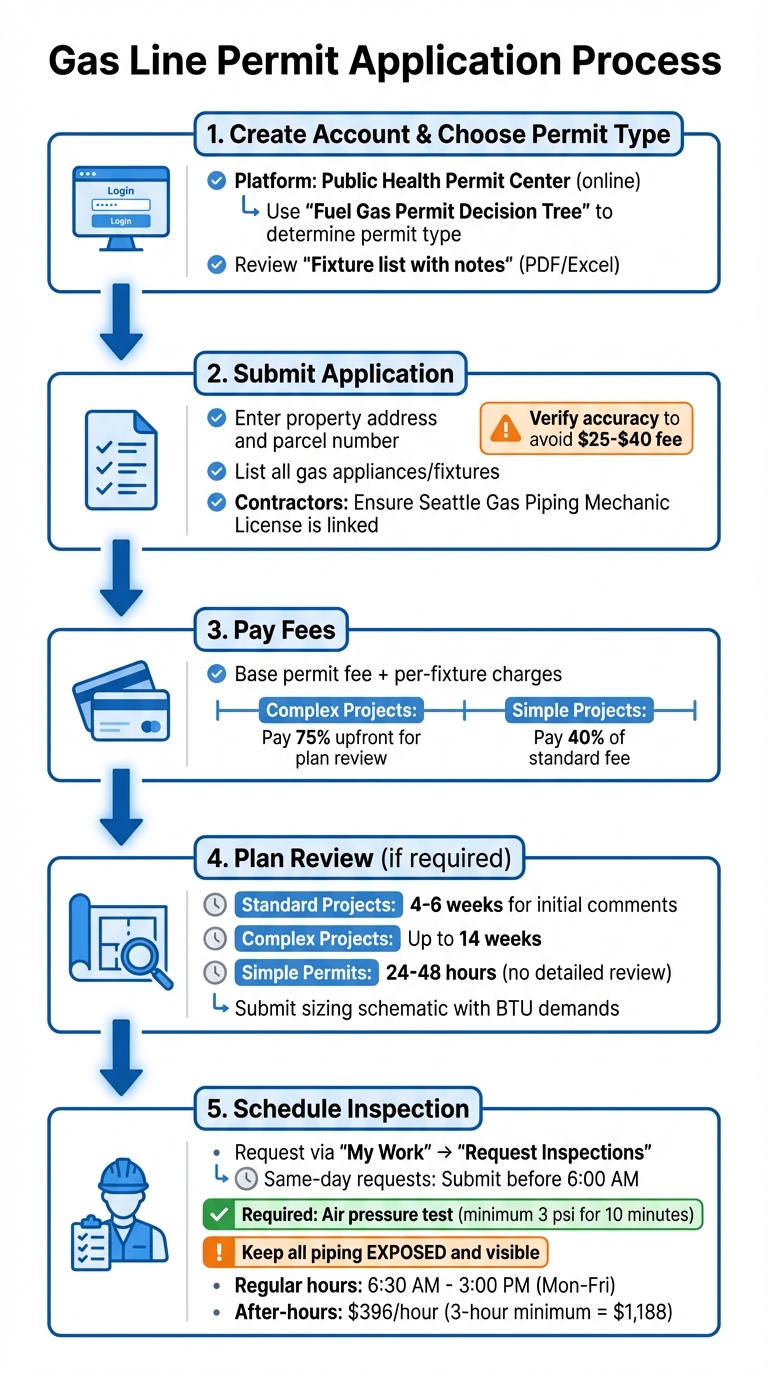
West Seattle Gas Line Permit Application Process: 5 Steps from Submission to Approval
Once you've confirmed the type of permit you need and identified your jurisdiction, you're ready to start the application process. Everything happens online through the Public Health Permit Center, where you’ll submit your application, upload necessary documents, pay fees, and schedule inspections.
Submitting Your Application
First, create an account on the Public Health Permit Center. Keep in mind that since the platform was updated in early 2026, there may be occasional service delays.
To determine the correct permit type, use the "Fuel Gas Permit Decision Tree". Most residential projects fall under standard "Fuel Gas" permits, but specialty permits are available for unique situations. Also, consult the "Fixture list with notes" (offered as a PDF or Excel file) to ensure you're accurately accounting for all gas appliances.
When completing your application, make sure to include all relevant project details. Double-check your property address and parcel number - mistakes here could result in extra fees. If you're a contractor, ensure your certification is up to date and linked to your account to avoid system errors when pulling the permit.
After entering all project details and fixture counts, you’ll pay the required fees: a base permit fee plus a per-fixture fee depending on the number of gas appliances being installed. Payments are processed directly through the portal.
Required Plans and Documents
For most residential gas line projects, a full plan review isn’t needed. However, more complex installations or certain types of properties may require you to submit design documents and schematics before your permit can be issued. Standard plan reviews typically take 4 to 6 weeks, while reviews for more involved projects can take up to 14 weeks.
If a plan review is required, you’ll need to upload a sizing schematic that details the pipe length from the gas meter to the farthest outlet. Include BTU demand figures for each appliance in your plans. Be sure to specify approved materials, such as black iron or corrugated stainless steel (CSST).
Once your plans are submitted and approved, you can move forward with scheduling your inspection.
Requesting and Passing Inspections
When your installation is complete, request an inspection through the Public Health Permit Center. Navigate to "My Work" and select "Request Inspections". For same-day inspections, submit your request before 6:00 am. Inspectors will call on the morning of your scheduled appointment to confirm the time.
Do not cover any gas piping before the inspection - the inspector must be able to see the entire system. Perform a leak test by spraying soapy water on all fittings; bubbles indicate leaks that need fixing.
During the inspection, your piping system must be under pressure. The air pressure test should be at least 1.5 times the working pressure or a minimum of 3 psi, held for at least 10 minutes. Use a mechanical gauge with a maximum range no more than five times the test pressure (e.g., a 15-pound gauge for a 3 psi test). The gauge must be visible when the inspector arrives.
To check the status of your inspection, visit the "My Work" section and look under the "Existing Inspections" tab. If you need an inspection outside of regular hours (6:30 am to 3:00 pm, Monday through Friday), these are available for $396 per hour with a 3-hour minimum ($1,188 total). Off-hour inspections must be arranged with a Senior Inspector at least 24 hours in advance.
Permit Costs, Processing Times, and Requirements
Once you've submitted your application, it's important to familiarize yourself with the fee structure, expected processing times, and potential inspection challenges.
How Permit Fees Are Calculated
Gas line permit fees typically include two parts: a base permit fee and an additional per-fixture charge for each gas appliance being installed. These fixtures could include items like a water heater, stove, dryer, or fireplace.
If your project requires a plan review, you'll need to pay 75% of the estimated fees when your application is accepted. However, simpler projects that qualify as "subject-to-field inspection" permits come with a reduced cost - only 40% of the standard plan review fee is charged, with the full payment due when the permit is issued.
To avoid extra charges, double-check all property details before submitting your application. Mistakes like entering the wrong property address or selecting the wrong jurisdiction can result in a change-of-address fee ranging from $25 to $40. Ensuring accuracy upfront can save both time and money.
How Long the Process Takes
For residential gas line permits requiring plan review, you can expect to receive initial comments within 4 to 6 weeks. If you're working on a larger or more complex project, the review process might take up to 14 weeks. On the other hand, straightforward permits that don't require detailed reviews can often be issued within 24 to 48 hours of submission.
"Based on the current volume of plumbing plan submittals, first review comments for most projects are at approximately 4 to 6 weeks. Please note, very large or complicated projects may take up to 14 weeks."
– King County Public Health
Be aware that delays may occur due to the ongoing transition to a new permit system. Once all reviewers approve your plans and you've made the final payments, the city typically takes around 2 weeks to issue your permit and provide the approved drawings digitally.
Common Inspection Problems and How to Avoid Them
One of the most common reasons for inspection failures is when gas piping is covered before the inspector has a chance to assess it. To avoid this, make sure all pipes remain exposed and visible during the inspection. Another frequent issue is insufficient pressure testing. Your system needs to maintain at least 1.5 times the working pressure or a minimum of 3 psi for 10 minutes to pass.
To prepare for your inspection, it's a good idea to perform a leak test yourself. Use soapy water on all fittings - if you see bubbles, you’ve got a leak that needs fixing before the inspector arrives.
West Seattle-Specific Factors
When tackling gas piping projects in West Seattle, there are unique local considerations beyond the standard permit procedures. These factors often stem from the area's older homes, seismic activity, and specific local regulations.
Older Homes and Remodeling Projects
West Seattle’s older homes come with their own set of challenges, especially during remodeling projects. Before diving into any work, it’s a good idea to schedule a Pre-Submittal Conference to address potential code issues upfront.
Many older homes have outdated systems that don’t align with current codes. For example, ground joint unions are no longer allowed except directly at the meter or after the appliance shutoff valve. If the home has a finished basement or a tight crawlspace, ensuring proper exposure for inspections and repairs becomes even more critical.
Another key concern is proper pipe sizing. Modern appliances like high-end gas ranges or fireplaces often require higher BTU capacities than older systems can handle. This means you’ll need to recalculate pipe sizes based on the total BTU demand and pipe length. Additionally, when retrofitting and cutting iron pipes, it’s crucial to ream the cuts to maintain the pipe’s full inside diameter for optimal gas flow.
These upgrades often trigger additional requirements under West Seattle’s specific seismic and structural standards, which are designed to address the area’s earthquake risks.
Earthquake and Structural Requirements
West Seattle's location in a seismically active region brings added safety requirements for gas systems. The city follows the 2021 Seattle Fuel Gas Code, which includes local amendments tailored to these risks. One of the most important safety measures is the installation of seismic shut-off valves. These valves automatically stop the flow of natural gas during significant earthquakes, reducing the risk of leaks, fires, and explosions.
"Seismic valves, also known as an earthquake shut-off valve, is a safety device installed on gas lines... During an earthquake, the strong shaking triggers the valve to automatically shut off the flow of natural gas."
– Landa Plumbing
These valves must be installed by a licensed plumber and are typically placed near the gas meter in an accessible, protected location. Once triggered, the valve remains closed until a qualified technician resets it after confirming safety. In addition, any new or modified gas lines must pass an air pressure test - holding at least 3 psi for a minimum of 10 minutes - under the supervision of a King County inspector.
Working with Licensed Plumbers
Navigating West Seattle’s complex code requirements is no small task, which is why hiring a licensed plumber is crucial. Only licensed professionals, such as those at Sasquatch Plumbing Services Seattle, are authorized to perform gas piping work on properties they don’t own. This ensures compliance with local regulations and streamlines the permit process.
"Within the City of Seattle only, a Seattle Gas Piping Mechanic License is required by anyone who installs gas piping on property they do not own."
– Public Health - Seattle & King County
Gas piping permits in West Seattle are issued by Public Health - Seattle & King County, not the standard building department. Licensed plumbers are well-versed in the technical requirements, such as air pressure testing, and they come prepared with the necessary equipment and gauges. For specialized materials like Corrugated Stainless Steel Tubing (CSST), they also hold manufacturer-specific certifications.
Another advantage of working with licensed professionals is avoiding costly mistakes. For instance, providing incorrect jurisdiction information can result in a $40 change-of-address fee. Additionally, plan reviews in the Seattle/King County area typically take 4 to 6 weeks for initial feedback, but more intricate projects can extend the timeline to as long as 14 weeks.
Conclusion
Getting a residential gas line permit in West Seattle is more than just a formality - it’s an essential step to protect your safety, your investment, and your peace of mind. A valid permit ensures that gas appliances receive the proper BTU input, enhances your home’s resale value, and guarantees insurance coverage when needed.
"There are several benefits to getting a permit for your project, including increasing the resale value, ensuring your insurance company will cover repairs, and avoiding complaints about unpermitted work."
– Seattle Department of Construction and Inspections
These permits aren’t just about following rules - they’re about ensuring your home is safe and up to code. Compliance with the 2021 Seattle Fuel Gas Code and local amendments is critical, and in Seattle, only licensed professionals can install gas piping on properties they don’t own. Specifically, they must hold a Seattle Gas Piping Mechanic License.
"Plumbing can be difficult. Public Health - Seattle & King County recommends you hire a professional plumber."
– Public Health - Seattle & King County
Licensed professionals, like those at Sasquatch Plumbing Services Seattle, simplify the process. They ensure your project complies with local regulations, handle the permit system efficiently, and make sure all work passes inspection on the first attempt. This not only saves time but also avoids costly errors, like the $40 change-of-address fee for incorrect jurisdiction information. Choosing experienced, licensed experts ensures your project is completed safely, correctly, and without unnecessary headaches.
FAQs
How do I apply for a residential gas line permit in West Seattle?
To get a residential gas line permit in West Seattle, start by reviewing the project guidelines provided by the Seattle Department of Construction & Inspections (SDCI). This involves checking your property’s zoning rules, any existing permits, and the specific gas piping requirements. Once you've gathered this information, head over to the Seattle Services Portal, where all permit applications are handled. If you don’t already have an account, you’ll need to create one.
After logging in, start a new utility permit application and select the type of permit you need. Be prepared to upload essential documents, including a site plan, gas piping design drawings, and any necessary authorization letters. Use the portal’s fee estimator to calculate the permit costs, then submit your payment electronically. Once your application is submitted, the city will review it. If there’s any feedback or required changes, you’ll need to address these promptly.
When your permit is approved, the next step is scheduling inspections - such as rough-in and final inspections - to ensure everything meets the required standards. Following these steps will help you stay compliant with local regulations and move your project forward smoothly.
Are homeowners allowed to install their own gas lines in West Seattle?
No, if you’re a homeowner in West Seattle, you cannot install your own residential gas lines. This type of work must be handled by a licensed contractor, and you’ll need to secure a gas-piping permit before starting any installation. These requirements are in place to ensure the work meets safety standards and complies with local building codes.
Bringing in a professional doesn’t just protect your home and family - it also helps you steer clear of fines or complications during inspections. Make sure to verify that your contractor is licensed and well-versed in West Seattle’s permitting process.
What are the most common issues during gas line inspections and how can I prevent them?
Common problems found during residential gas line inspections in West Seattle often stem from issues like improper tank placement, insufficient support, missing safety signage, or incorrect pipe sizing. For instance, tanks need to follow strict setback rules - such as being at least 10 feet away from buildings or vegetation for tanks holding 125–500 gallons - and they must be securely anchored, especially in areas prone to flooding. Additionally, gas piping must be sized correctly to meet the home's gas demand, clearly labeled, and all joints should undergo pressure testing before the inspection. Other common reasons for failing inspections include using unapproved appliances or neglecting to secure the required permits.
To steer clear of these pitfalls, make sure your installation aligns with local codes, use approved materials, and correctly label all components. Obtain the necessary permits well in advance and hire a licensed professional to handle the work. Taking these precautions can help ensure a smooth inspection process, avoid unnecessary delays, and create a safe, code-compliant gas line for your home.