Seattle's plumbing codes for backflow prevention are designed to protect drinking water from contamination caused by reverse water flow. Backflow occurs through two main mechanisms: back-pressure (when downstream pressure exceeds supply pressure) and back-siphonage (when a drop in supply pressure creates a vacuum). Common sources of backflow risks include irrigation systems, swimming pools, boilers, and fire sprinklers.
Key requirements include:
- Mandatory Backflow Devices: Property owners must install approved backflow prevention assemblies based on hazard levels (e.g., Reduced Pressure Assemblies for high-risk areas like hospitals or chemical plants).
- Annual Testing: Devices must be tested yearly by a certified Backflow Assembly Tester (BAT), and results submitted to Seattle Public Utilities (SPU).
- Compliance Enforcement: Non-compliance can lead to fines, water service termination, and additional costs for repairs or reconnection.
Seattle follows the 2021 Washington State Plumbing Code with local amendments, requiring permits and adherence to strict installation and testing standards. For help, property owners can contact SPU or licensed plumbers like Sasquatch Plumbing Services Seattle, who manage installations, testing, and compliance documentation.
Takeaway: Installing and maintaining backflow prevention devices is not just a legal requirement but also critical for safeguarding public and private water supplies.
Backflow Prevention Training
Washington State Backflow Regulations: WAC 246-290-490
WAC 246-290-490 outlines the essential requirements for cross-connection control programs, ensuring the safety of public drinking water across all water systems in Washington State.
"The purpose of the purveyor's cross-connection control program shall be to protect the public water system... from contamination via cross-connections." – WAC 246-290-490
This regulation clearly divides responsibilities. Water purveyors, such as Seattle Public Utilities, are accountable for maintaining water quality up to the meter. Meanwhile, property owners must manage on-site cross-connections in compliance with RCW 19.27.
To comply, every water purveyor is required to establish a written cross-connection control program. This program must include at least 10 key components, such as legal authority, hazard assessments, recordkeeping, and public education. It must also be developed by a certified Cross-Connection Specialist (CCS). Additionally, backflow prevention devices must be tested by a certified Backflow Assembly Tester (BAT).
Non-compliance can result in service termination. For properties with high-health hazards, such as hospitals or chemical plants, backflow protection devices must be installed within 90 days. Records of these measures must be maintained for a minimum of five years.
Seattle Plumbing Code Requirements for Backflow Prevention
Seattle follows the 2021 Washington State Plumbing Code with additional local amendments. These amendments are enforced by Public Health - Seattle & King County (PH-S&KC) in collaboration with Seattle Public Utilities (SPU). The local amendments address specific hazards based on individual site conditions.
"Seattle Public Utilities' certified Cross-connection Control Specialists make the determination of what type of protection is required for each specific installation." - Seattle Public Utilities
The requirements are divided by the level of hazard posed. For high-hazard facilities - such as hospitals, laboratories, car washes, chemical plants, and commercial laundries - a Reduced Pressure Backflow Assembly is mandatory. Low-hazard systems, including irrigation systems and fire sprinklers in multi-story buildings, can use options like a Double Check Valve, Pressure Vacuum Breaker, or Spill-resistant Vacuum Breaker Assemblies. These rules align with state laws to ensure installations meet both local and state standards.
For residential properties, specific devices are required depending on the application. Backflow prevention is typically necessary for irrigation systems, swimming pools, spas, boilers, and solar water heating systems. Fire sprinkler systems also require backflow prevention unless they are approved flow-through systems. Properties using both reclaimed water and potable water are classified as high health hazards, requiring the highest level of protection.
Before installation, property owners must confirm that their backflow assembly is included on the Washington State Department of Health's approved list, managed by the USC Foundation for Cross-Connection Control and Hydraulic Research. Once installed, all assemblies must be tested by a State-certified Backflow Assembly Tester (BAT) and retested annually. Test reports need to be submitted to SPU or the appropriate authority. For questions about plan reviews or determining the correct assembly for new projects, property owners can contact SPU at [email protected].
Types of Backflow Prevention Devices and When to Use Them
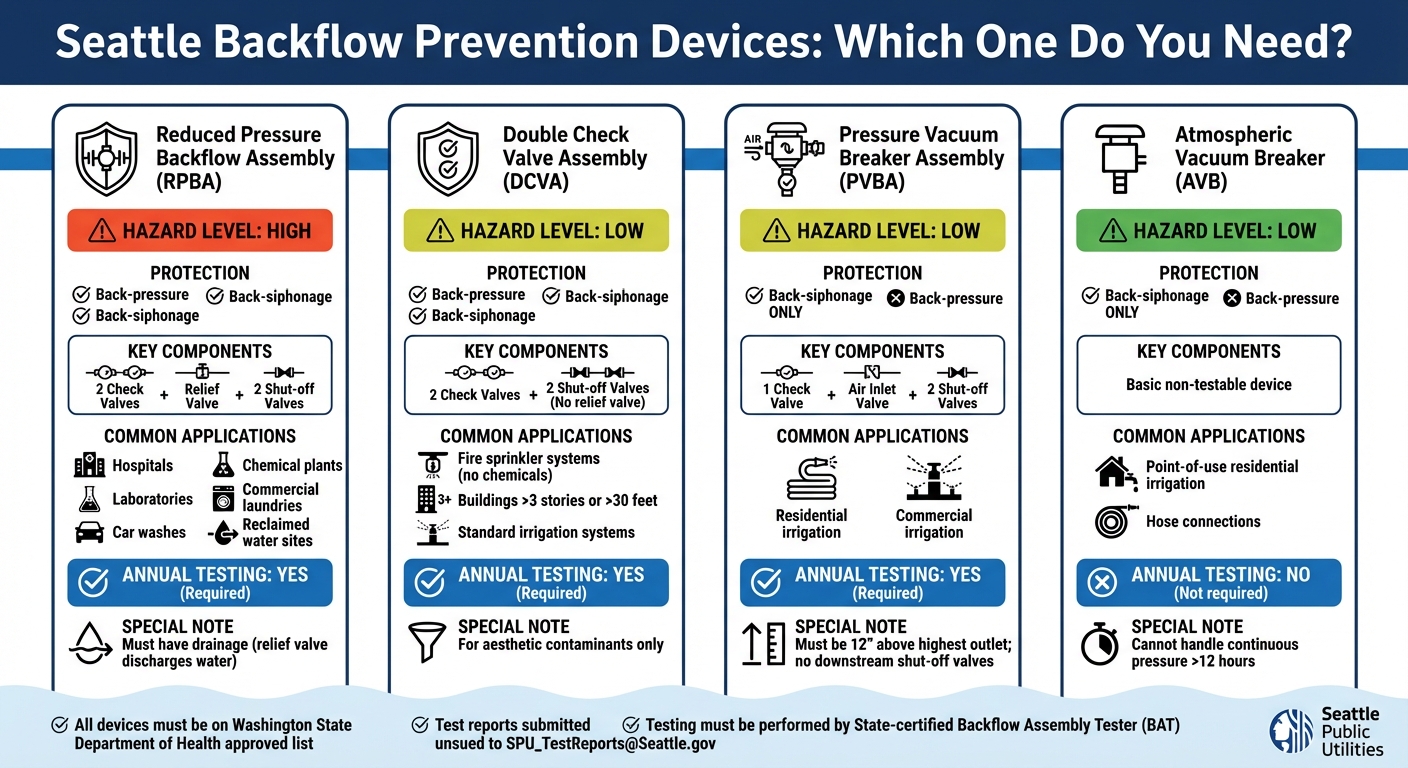
Seattle Backflow Prevention Devices Comparison Guide
Seattle plumbing codes acknowledge four main types of backflow prevention assemblies, each tailored to specific hazard levels and hydraulic conditions. Choosing the right device depends on the type of backflow risk: back-pressure, which happens when downstream pressure surpasses supply pressure, or back-siphonage, which occurs when supply pressure drops enough to create a vacuum. It's crucial to ensure the selected device is listed on the Washington State Department of Health's approved list. Here's a breakdown of each assembly type, including their design, applications, and testing requirements.
Reduced Pressure Backflow Assemblies (RPBA)
For high-risk situations, Seattle mandates the use of Reduced Pressure Backflow Assemblies (RPBA), which offer the highest level of protection. These assemblies include two independently loaded check valves, a spring-loaded differential pressure relief valve, and two resilient seated shut-off valves. If either check valve fails, the relief valve automatically discharges water to prevent contamination of the public water supply.
RPBAs are required in installations such as hospitals, laboratories, car washes, chemical plants, commercial laundries, metal plating facilities, film processing centers, morgues, and sites using both reclaimed and potable water. Since the relief valve can release water during pressure changes or valve failures, these assemblies must be installed in locations with proper drainage.
Double Check Valve Assemblies (DCVA)
Double Check Valve Assemblies (DCVA) are designed for low-risk applications where potential contaminants are more of an aesthetic issue than a health hazard. These assemblies consist of two independently loaded check valves and two resilient seated shut-off valves but lack a relief valve. This makes them suitable for scenarios where contaminants pose no serious health risk.
In Seattle, DCVAs are commonly used in fire sprinkler systems (as long as no chemicals are added), buildings taller than three stories or 30 feet, and standard irrigation systems. For fire protection lines, specialized detector assemblies (DCDA) with a bypass meter are often installed to monitor unauthorized water use or leaks.
Pressure Vacuum Breaker Assemblies (PVBA)
Pressure Vacuum Breaker Assemblies (PVBA) are testable devices that exclusively protect against back-siphonage. They feature an internally loaded check valve, an independently operating air inlet valve, and two resilient seated shut-off valves. When supply pressure drops, the air inlet valve opens to break the vacuum, stopping reverse flow.
In Seattle, PVBAs are commonly used in residential and commercial irrigation systems. Installation height is critical - these assemblies must be mounted at least 12 inches above the highest downstream piping or outlet. Downstream shut-off valves are not allowed, as they could create sustained back-pressure. Additionally, proper winterization is necessary to avoid freezing damage.
Atmospheric Vacuum Breaker Assemblies (AVB)
Atmospheric Vacuum Breakers (AVB) are the simplest devices for backflow prevention, providing basic protection against back-siphonage. These non-testable devices are ideal for point-of-use residential applications, especially for irrigation connections. However, AVBs cannot handle continuous pressure for more than 12 hours, making them unsuitable for systems under constant pressure.
In Seattle, AVBs are approved for low-risk residential uses. Like all devices, they must be included on the Washington State approved list.
Backflow Prevention Assembly Comparison Table
| Assembly Type | Hazard Level | Protects Against | Common Seattle Applications | Annual Testing Required |
|---|---|---|---|---|
| Reduced Pressure (RPBA) | High | Back-pressure & Back-siphonage | Hospitals, laboratories, car washes, chemical plants, commercial laundries, sites using reclaimed water | Yes |
| Double Check (DCVA) | Low | Back-pressure & Back-siphonage | Fire sprinkler systems (without chemicals), buildings >3 stories/30 ft, standard irrigation | Yes |
| Pressure Vacuum Breaker (PVBA) | Low | Back-siphonage only | Residential and commercial irrigation systems | Yes |
| Atmospheric Vacuum Breaker (AVB) | Low | Back-siphonage only | Point-of-use residential irrigation (non-continuous pressure) | No |
All testable assemblies must undergo annual testing by a certified Backflow Assembly Tester (BAT).
Installation Requirements and Permits in Seattle
Before installing any backflow prevention assembly in Seattle, you must first secure a permit from Public Health – Seattle & King County (PH-S&KC). This is a requirement under the 2021 Washington State Plumbing Code, including Seattle-specific amendments.
To ensure compliance, reach out to SPU's certified Cross-connection Control Specialists at [email protected]. They’ll help you identify the correct assembly for your property based on its hazard level, aligning your plans with both state and local regulations.
Make sure the device you choose is listed on the USC Foundation's approved list (usclist.com). Once installed by a licensed plumber, you’ll need to hire a State-certified Backflow Assembly Tester (BAT) to conduct the initial test. The completed test report must then be submitted to [email protected]. You can find certified testers through the Washington Certification Services registry.
To stay compliant, ensure all required documentation is submitted. This includes the BAT's test report and any necessary inspection approvals from PH-S&KC. Missing these steps could lead to non-compliance fees or even water service termination.
If your property is in Shoreline but receives water from SPU, remember that the City of Shoreline serves as the local authority.
sbb-itb-6ceaf48
Annual Testing and Inspection Requirements
Under Washington State law (WAC 246-290-490 and WAC 246-292-036), annual testing is required to ensure your backflow device is functioning correctly. This testing plays a vital role in protecting Seattle's drinking water from contamination due to back-pressure or back-siphonage. In addition to the yearly requirement, testing must also be conducted immediately after any repairs or replacements of your backflow device. Following these steps helps keep your assembly compliant and effective.
A Certified Backflow Assembly Tester (BAT) must perform the testing. Before hiring a tester, confirm their credentials on the Washington Certification Services website. The tester will send the results directly to SPU at [email protected], but it’s a good idea to request a copy for your own records. Keep in mind, SPU only accepts test reports from testers who have current state certification and properly calibrated equipment.
If your assembly fails its test, it must be repaired and re-tested immediately to stay compliant and ensure water quality remains intact. Quick action after a failed test is critical to avoid interruptions to your water service.
It’s your responsibility to schedule tests on time. Missing your annual test could lead to non-compliance charges or even water service termination. To avoid last-minute complications, schedule your test early. If you receive an enforcement notice, contact SPU right away at (206) 684-3536 or email [email protected].
Penalties for Non-Compliance
Seattle Public Utilities (SPU) takes backflow prevention seriously, enforcing regulations through corrective action letters or warning notices. These notices provide property owners with a 30-day window to complete required testing or install necessary equipment.
Missing this deadline can lead to Testing Non-compliance Charges added to your utility account. Initial fines start at $100 and can escalate to $100 per day for each day the issue remains unresolved. On top of these fines, property owners might face extra costs for emergency repairs and fees to restore water service.
If non-compliance continues, SPU may terminate water service altogether. Losing water service not only disrupts daily life but also classifies the property as "unfit for human habitation." For instance, in October 2025, the Washington Department of Ecology and the EPA fined the City of Seattle $35,000 for sanitary sewer overflow violations occurring between January 1 and December 31, 2024. Additionally, failing to submit annual backflow test results can lead to mounting fines and eventual water disconnection.
To avoid these severe consequences, take immediate action if you receive an enforcement notification. Reach out to SPU by calling (206) 684-3536 or emailing [email protected]. Acting quickly helps prevent escalating penalties and ensures uninterrupted water service. Be sure to maintain detailed records of all maintenance and testing to verify compliance when needed.
How Sasquatch Plumbing Services Seattle Can Help
Sasquatch Plumbing Services Seattle makes navigating Seattle's strict backflow prevention requirements much easier. Their team of licensed plumbers is ready to assist West Seattle homeowners with everything from installing backflow prevention devices to handling annual testing. Every installation is completed in full compliance with the 2021 Seattle Plumbing Code and Washington Administrative Code (WAC) 246-290-490, ensuring your system meets the necessary standards from day one.
For high-risk situations - like pools, spas, or irrigation systems using chemicals - they install Washington State-approved Reduced Pressure Backflow Assemblies (RPBAs). For lower-risk scenarios, Double Check Valve Assemblies (DCVAs) are recommended. Before any work begins, certified testers conduct the required inspections to ensure everything is set up correctly. Beyond installation, they provide immediate repairs and routine inspections to keep your system running smoothly.
To save you the hassle, Sasquatch Plumbing Services Seattle handles all test report submissions directly to [email protected]. This helps you avoid non-compliance fees or, worse, water shutoffs. Plus, they offer upfront pricing with no hidden costs, so you always know what to expect.
When emergencies strike - whether it’s back-pressure from a faulty boiler or back-siphonage caused by a water main break - their same-day services are there to resolve backflow issues quickly. They also help you stay compliant by scheduling annual inspections within Seattle Public Utilities' required timeframes.
Even though Sasquatch Plumbing Services Seattle submits all test reports on your behalf, it’s a good idea to keep copies of the documentation for your records. Their team ensures every installation aligns with the current USC Foundation for Cross-Connection Control and Hydraulic Research approval list, seamlessly incorporating Seattle’s regulatory standards into every service they provide.
Conclusion
Complying with Seattle's backflow prevention codes isn’t just about following the rules - it’s about safeguarding your family’s drinking water and the city’s entire water supply from potential contamination. As Seattle Public Utilities warns, “A cross-connection within private water piping systems can threaten the quality of the customer's drinking water first and then threaten the city's drinking water as well”. Without properly installed backflow devices and routine yearly testing, contaminants can flow backward into your potable water system.
Ignoring these regulations, including Washington Administrative Code (WAC) 246-290-490 and Seattle Municipal Code 21.04.070, can result in fines, water service termination, and, most importantly, compromised water safety. Annual testing by a State of Washington Certified Backflow Assembly Tester is required to confirm the system is functioning correctly. As SPU highlights, “The only way to ensure that they are functioning properly is through annual testing by a certified Backflow Assembly Tester”.
Sasquatch Plumbing Services Seattle takes the stress out of staying compliant. Their licensed professionals manage everything - from selecting the right backflow device based on your hazard level to submitting test reports directly to Seattle Public Utilities. With transparent pricing and same-day emergency services, they make sure your backflow prevention system is up to code, all while sparing you the headache of navigating complex regulations.
FAQs
What types of properties are considered high-risk for backflow in Seattle's plumbing systems?
High-risk properties for backflow in Seattle are generally those equipped with irrigation systems, swimming pools, spas, fire sprinkler systems, or facilities that manage chemical or hazardous materials. These setups can create opportunities for contaminants to seep into the potable water supply.
To meet Seattle's plumbing codes and safeguard water quality, it's essential to install the right backflow prevention devices and keep them regularly inspected. Not sure if your property falls into the high-risk category? A licensed professional can assess your situation and ensure you're both protected and compliant.
How often do backflow prevention devices need testing in Seattle?
In Seattle, backflow prevention devices need to be tested annually to ensure they’re working as they should. This yearly check is mandated by Seattle Public Utilities and Washington State regulations to safeguard the public water supply from potential contamination.
To stay compliant with local laws and uphold water safety standards, it’s essential to hire a certified professional for the testing. Regular inspections can catch and fix problems early, preventing them from escalating into bigger issues.
What happens if I don’t follow Seattle’s backflow prevention codes?
Failing to follow Seattle's backflow prevention codes can bring about serious problems. You could face fines starting at $100, disruptions to your water service, and even legal action. If violations continue, the penalties can escalate, leading to steeper fines and harsher consequences.
The good news? You can steer clear of these headaches by making sure your backflow prevention systems are correctly installed, regularly maintained, and tested according to local requirements. Staying on top of compliance not only keeps you out of trouble but also safeguards your community's water supply from contamination risks.