
Want to save water, energy, and money while protecting the planet? Eco-friendly plumbing upgrades are the way to go. From low-flow fixtures to energy-efficient water heaters, these solutions reduce waste, cut utility bills, and help preserve water resources. Here’s a quick breakdown of the best upgrades:
- Low-Flow Faucets & Showerheads: Use up to 32% less water without losing pressure. Save up to 3,400 gallons annually.
- Dual-Flush Toilets: Reduce water use by 20%-60%, saving $170+ per year.
- Tankless & Heat Pump Water Heaters: Slash energy costs by up to $600 annually while lasting longer than traditional heaters.
- Greywater Recycling Systems: Reuse wastewater for irrigation, saving 40,000 gallons of water annually.
- Smart Leak Detection Systems: Prevent leaks, save up to 50,000 gallons of water, and avoid costly damage.
These upgrades not only lower your bills but also help safeguard water supplies for future generations. Let’s dive into the details and see how you can make your home more efficient.
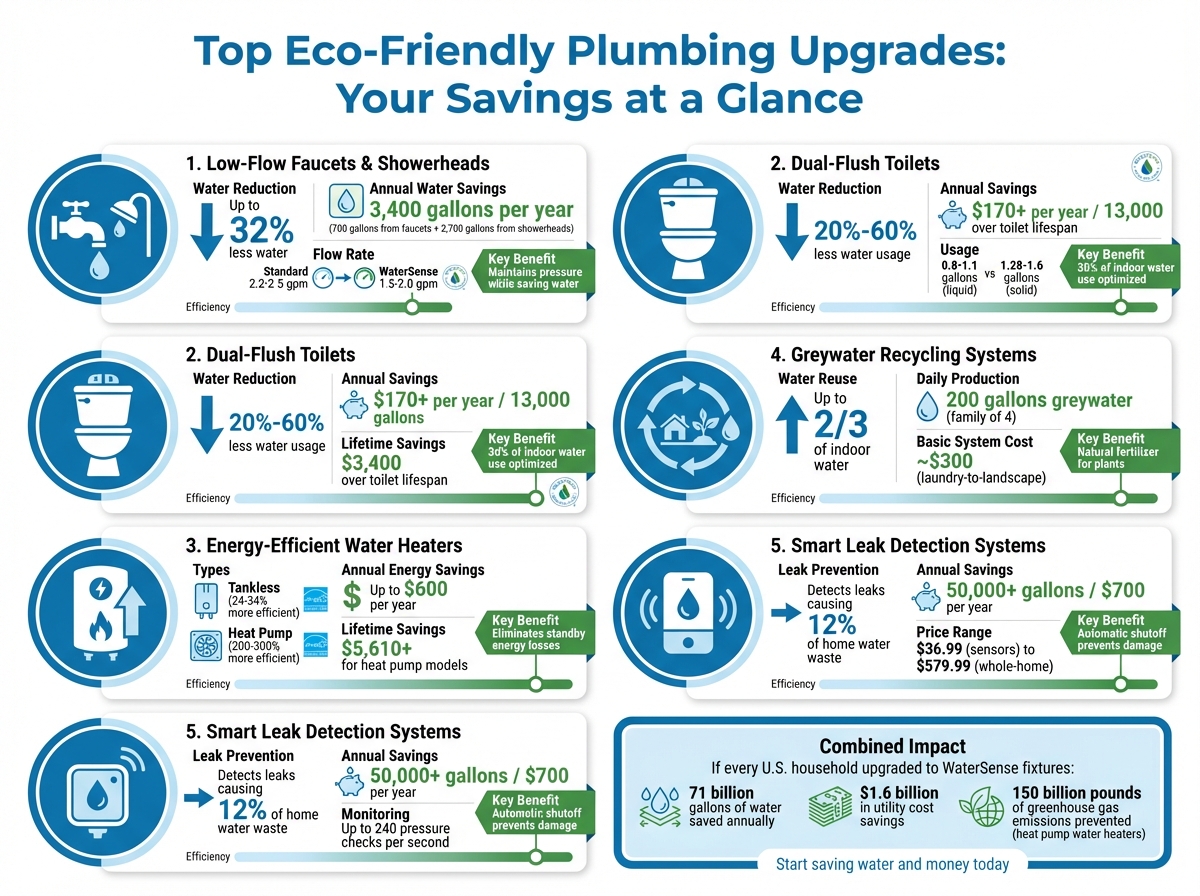
Top 5 Eco-Friendly Plumbing Upgrades: Water & Cost Savings Comparison
Low-Flow Faucets and Showerheads
What Are Low-Flow Fixtures?
Low-flow fixtures are an effective way to cut down on water and energy waste at home. These fixtures, like aerators and air-assisted showerheads, mix air with water to maintain strong pressure while reducing the flow rate. Thermostatic Shut-off Valves (TSVs) add another layer of efficiency by slowing water flow once the desired temperature is reached.
For comparison, standard bathroom faucets typically flow at 2.2 gallons per minute (gpm). In contrast, WaterSense models are designed to use only 1.5 gpm, which is a 32% reduction. Similarly, while standard showerheads flow at 2.5 gpm, WaterSense-certified options use 2.0 gpm or less. California has even stricter standards, requiring showerheads sold after July 2018 to operate at no more than 1.8 gpm.
Benefits of Low-Flow Fixtures
Upgrading to low-flow fixtures can lead to substantial water and energy savings. For instance, replacing outdated faucets and aerators can save an average family about 700 gallons of water each year. Switching to a WaterSense showerhead adds even more savings - up to 2,700 gallons annually. These savings extend beyond water, as reduced hot water use means lower energy consumption. To put it into perspective, the energy saved is comparable to running a hairdryer for 17 minutes every day for a year.
The impact grows exponentially when scaled to a national level. If every household in the U.S. upgraded to WaterSense faucets and aerators, the collective savings could reach 71 billion gallons of water and nearly $1.6 billion in utility costs each year. Even something as small as a dripping faucet - losing just one drip per second - can waste over 3,000 gallons of water annually.
How to Choose Low-Flow Fixtures
To ensure you're getting the most efficient fixtures, look for the WaterSense label. This certification guarantees the product meets EPA standards for both efficiency and performance. WaterSense fixtures are also tested to perform well in homes with low water pressure and are certified to be lead-free. If replacing an entire faucet isn't necessary, installing a WaterSense aerator can still deliver notable water savings. Not sure if your faucet has an aerator? A smooth, clear water stream instead of a white, bubbly one is a good indicator that you're missing one.
Many local utilities offer rebates to encourage the adoption of WaterSense fixtures and TSVs. For example, Seattle City Light has provided $15 rebates for TSVs. Additionally, most aerators and showerheads are easy to install with basic tools. If you need help, Sasquatch Plumbing Services in Seattle offers professional installation and advice to ensure a seamless upgrade for West Seattle homeowners.
sbb-itb-6ceaf48
Dual-Flush Toilets
How Dual-Flush Toilets Work
Dual-flush toilets are designed with two flush options: a low-volume flush for liquid waste (using 0.8–1.1 gallons) and a full flush for solid waste (using 1.28–1.6 gallons). These toilets rely on a gravity-fed system, featuring a larger 4-inch trapway that clears the bowl more efficiently. The water line is positioned lower, reducing the need for a high water level to create a siphoning effect. To meet the EPA's WaterSense standards, the average water usage must not exceed 1.28 gallons per flush. The real savings, however, depend on consistently opting for the low-volume flush. These smart design features not only conserve water but can also lead to noticeable cost reductions.
Why Dual-Flush Toilets Save Money
Toilets are responsible for about 30% of a household's indoor water usage. Older toilet models can use as much as 6 gallons per flush, compared to modern designs that require just 1.6 gallons. Switching to a high-efficiency dual-flush toilet can cut toilet water usage by 20% to 60%.
The financial benefits are just as compelling. A family using WaterSense-labeled toilets can save around 13,000 gallons of water annually, which translates to over $170 in water bill savings each year. Over the lifespan of the toilet, this can add up to approximately $3,400. For homeowners in West Seattle, replacing toilets made before 2004 might qualify for a $100 rebate through the Saving Water Partnership. Premium models that use 1.1 gallons per flush or less could save up to $200 per year on water and sewer costs.
If replacing the entire toilet isn’t an option, retrofitting your existing one with a dual-flush mechanism is an affordable alternative, costing about $30. For professional installation or advice on choosing the right model for your West Seattle home, Sasquatch Plumbing Services is available to help ensure the upgrade is done correctly.
Eco-Friendly Plumbing Solutions for the Modern Home | Sustainable Plumbing Tips & Innovations
Energy-Efficient Water Heaters
Water heating accounts for about 18% of home energy use, costing homeowners between $400 and $600 annually. Upgrading to an energy-efficient water heater can significantly cut costs and reduce environmental impact.
Two popular options - tankless water heaters and heat pump water heaters - offer unique ways to conserve energy. Let’s dive into how these systems work and the benefits they bring, along with the rebates that can help offset the cost.
Tankless Water Heaters
Tankless water heaters heat water on demand, meaning they only heat water as it’s needed. This eliminates the energy waste associated with keeping a full tank of water hot all day and night.
"Tankless water heaters, also known as demand-type or instantaneous water heaters, provide hot water only as it is needed. They don't produce the standby energy losses associated with storage water heaters, which can save money." - Department of Energy
These systems are 24%–34% more efficient for households using 41 gallons or less of hot water daily, and they still offer 8%–14% savings for higher water usage. ENERGY STAR-certified tankless models can save over $100 annually compared to standard gas storage water heaters.
Their compact size makes them a great fit for homes in areas like West Seattle, where space can be limited. Gas-powered tankless units typically handle higher flow rates than electric ones but require proper venting. On average, tankless systems provide 2–5 gallons of hot water per minute, which is sufficient for single-use scenarios but might fall short when multiple fixtures are in use simultaneously - like running a shower and dishwasher at the same time. In such cases, installing multiple units or adding point-of-use heaters can solve the problem.
Tankless water heaters also have a longer lifespan, lasting over 20 years compared to the 10–15 years typical of storage water heaters. Replaceable components can extend their usability even further. If you’re considering a tankless upgrade, Sasquatch Plumbing Services Seattle can help determine the right size and setup for your household’s needs.
While tankless systems are efficient and durable, heat pump water heaters offer even greater energy savings.
Heat Pump Water Heaters
Heat pump water heaters work by transferring heat from the surrounding air into a storage tank, much like a refrigerator in reverse. This approach uses electricity more efficiently than traditional methods.
"Heat pump water heaters use electricity to move heat from one place to another instead of generating heat directly. Therefore, they can be two to three times more energy efficient than conventional electric resistance water heaters." - Department of Energy
ENERGY STAR-certified heat pump models are 200%–300% more efficient than standard electric water heaters. For a household of four, switching to a heat pump water heater can save $550–$600 annually on electricity bills, with lifetime savings exceeding $5,610. These systems typically use just one-quarter of the energy required by conventional electric water heaters.
Heat pump water heaters require a space of 700–1,000 cubic feet (about a 10' x 10' room) and operate best in temperatures between 40°F and 90°F. In colder conditions, they may switch to a backup electric resistance mode. Placing the unit in a warm area, like a furnace room, can improve its efficiency while also cooling and dehumidifying the surrounding space - an added bonus during Seattle’s warm, humid summers.
These systems generally last 10–15 years and require regular air filter maintenance to ensure proper airflow. Since they rely on a storage tank, it’s important to consider the "first-hour rating", which indicates how much hot water is available during peak demand. Proper planning ensures you get the right size and placement for your home.
Rebates and Incentives for Water Heater Upgrades
Although energy-efficient water heaters often come with a higher upfront cost, rebates and incentives can make them more affordable while offering long-term savings.
Federal and local programs, such as the Energy Efficient Home Improvement Credit, can cover 30% of your project costs through IRS Form 5695. Heat pump models may qualify for up to $2,000 annually, while high-efficiency gas, propane, or oil heaters can earn up to $600. This credit applies to existing homes used as primary residences, and even second homes are eligible.
Starting in 2025, you’ll need to include a Qualified Manufacturer Identification Number (QMID) on your tax return to claim this credit. Look for water heaters that meet or exceed the Consortium for Energy Efficiency (CEE) highest efficiency tier to qualify. Since the credit has an annual cap rather than a lifetime limit, you can spread multiple energy upgrades over several years to maximize your savings.
Local utility companies also offer rebates and discounts for installing energy-efficient systems. For example, the payback period for a heat pump water heater is typically around three years for a household of four, after which the energy savings turn into pure profit.
If every electric water heater sold in the U.S. were an ENERGY STAR-certified heat pump model, it could prevent 150 billion pounds of greenhouse gas emissions annually - the same as taking 14 million cars off the road. For help selecting and installing the right energy-efficient water heater - and to ensure you take full advantage of available rebates - reach out to Sasquatch Plumbing Services Seattle.
Greywater Recycling Systems
Greywater recycling involves reusing wastewater from baths, showers, sinks, and washing machines to water your yard. This not only cuts down on water bills but also helps conserve resources.
What Is Greywater Recycling?
Greywater refers to wastewater from sources like bathtubs, showers, bathroom sinks, and washing machines - essentially any wastewater except what comes from toilets and urinals. On average, a family of four generates about 200 gallons of greywater every day.
The recycling process has three main steps: diversion, filtration, and distribution. First, the water is redirected using a 3-way diverter valve. Then, it goes through coarse filters - typically made of sand and gravel - to remove debris, hair, and grease. Finally, the filtered water is distributed, either through gravity or with the help of a pump, to irrigate plants and trees below ground level.
In Washington state, greywater is categorized into "light greywater" (from showers, tubs, and laundry) and "dark greywater" (from kitchen sinks and dishwashers). Dark greywater has more grease and pathogens, making it harder to treat, while light greywater is easier to reuse.
"The system merely redirects water. You're going to take a shower and pretty much at the same time you're going to water your plants."
- Remy Sabiani, Owner, Water Wise Group
For a basic gravity-fed system to work smoothly, a minimum slope of 2% (or a 1/4 inch drop per foot) is required to prevent clogs. More advanced setups can even treat greywater for reuse in toilets, but these systems require extra pumps and filtration.
Benefits of Greywater Systems
With a greywater system, homeowners can reuse about two-thirds of their indoor water for outdoor irrigation. This can save up to 40,000 gallons of water annually, which is particularly helpful since outdoor water use often makes up 30% to 70% of total water bills. Additionally, reusing greywater reduces the load on septic systems, potentially extending their lifespan.
Greywater contains nutrients that act as natural fertilizers for plants and fruit trees. A simple "laundry-to-landscape" system, which connects directly to a washing machine’s pump, costs around $300 in materials, making it a budget-friendly option for DIY enthusiasts.
However, timing is key - greywater should be used within 24 hours to avoid unpleasant odors and nutrient loss. To minimize health risks, always discharge greywater below ground using a drainfield or mulch basin to prevent pooling. When selecting detergents, opt for plant-friendly products and steer clear of those with high levels of salt, boron, or chlorine bleach, as these can damage soil and plants.
Before setting up a system, it’s essential to understand installation requirements and local regulations to ensure everything is compliant.
Installation Requirements and Local Regulations
Greywater systems offer a sustainable way to reduce water usage and lower utility costs. However, before installing one in West Seattle, it’s crucial to review both state and local regulations. Washington’s Chapter 246-274 WAC governs subsurface irrigation systems, while the Washington State Plumbing Code (Chapter 51-56-1600 WAC) applies to indoor reuse systems. Permits are typically issued by Public Health – Seattle & King County or your local building department.
Every system must include a diversion valve to redirect greywater back to the sewage system when the recycling system isn’t in use or during the off-season. Subsurface irrigation systems are generally intended for temporary, seasonal use. Additionally, all greywater pipes must be labeled with "CAUTION: NONPOTABLE GRAY WATER, DO NOT DRINK" at intervals of 5 feet or less.
| Project Type | Source | Storage Limit | Max Quantity | Treatment Requirements |
|---|---|---|---|---|
| Tier 1 | Light Greywater | None (Gravity only) | <60 gallons/day | No treatment required |
| Tier 2 | Light Greywater | <24 hours | <3,500 gallons/day | No treatment; even distribution |
| Tier 3 | Dark Greywater | No limit | <3,500 gallons/day | Treatment required |
Tier 1 systems, which rely on gravity, are the most affordable. However, Tier 2 and Tier 3 systems, which involve additional equipment, come with higher costs. Retrofitting an existing home for greywater can also be expensive and less practical compared to installing one during new construction.
Before moving forward, consult with the King County local health jurisdiction to confirm that your system type is allowed, as local rules may be stricter than state guidelines. For expert advice and to ensure compliance, Sasquatch Plumbing Services Seattle can evaluate your property and plumbing setup to determine if a greywater system is right for your home.
Other Water-Saving Upgrades
In addition to upgrading major fixtures, there are smaller, targeted improvements that can make a big difference in your home's water and energy efficiency. These upgrades work with your existing plumbing to cut waste, lower utility costs, and align with eco-conscious goals.
Smart Leak Detection Systems
Did you know leaks are responsible for about 12% of all water used in homes? That’s why catching them early is so important. Smart leak detection systems use sensors to identify problems before they escalate, sending instant SMS or push notifications as soon as an issue arises.
Take the Phyn Plus Smart Water Assistant, for example. At $579.99, this system connects to your main water line and monitors pressure changes up to 240 times per second. It can even distinguish between normal usage and a burst pipe. If a leak is detected, it can automatically shut off your main water supply, protecting your home from damage and saving irreplaceable belongings. For more focused protection, point-of-leak sensors (starting at $36.99 each) can be placed in vulnerable spots like under sinks, near washing machines, or next to water heaters. The EcoNet BullDog WiFi Automatic Water Shut Off, which includes three sensors, is a budget-friendly option at $319.95.
Some systems go beyond leak detection, offering fixture-specific water usage reports to help you spot inefficient fixtures. Others provide alerts for conditions that might lead to frozen pipes.
"This device can prevent costly water damage to your home and help you use a precious resource more wisely." - TechHive
For whole-home shut-off valves, professional installation is recommended since these systems require cutting into your main water line. Homes equipped with WaterSense-labeled fixtures and monitoring systems can save over 50,000 gallons of water and $700 annually in combined water and energy costs.
Hot Water Pipe Insulation
Insulating your hot water pipes is a simple DIY project that reduces heat loss and water waste. Without insulation, heat escapes as hot water travels through the pipes, forcing you to run the faucet longer while cold water goes down the drain. Insulated pipes keep water warmer, reducing wait times and cutting waste.
For the best results, insulate both the water heater tank and connecting hot water pipes, especially in unconditioned areas like basements or crawlspaces where heat loss happens faster. While insulating, it’s a good time to check for leaks, worn-out gaskets, loose connections, or signs of corrosion. Pairing pipe insulation with a lower water heater thermostat setting can also help reduce energy bills.
Water Filtration Systems
A water filtration system not only improves the quality of your drinking water but also protects your plumbing and appliances from sediment and mineral buildup. The key is choosing the right system based on your water quality and household needs.
Start with a water test to identify contaminants, which will help you select the right filtration system. Whole-house systems (point-of-entry) treat all the water entering your home, while under-sink or pitcher filters (point-of-use) focus on specific areas like drinking and cooking.
Different systems address different concerns. Activated carbon filters remove chlorine, unpleasant odors, and certain chemicals without wasting water. UV disinfection systems kill 99.99% of bacteria and viruses without using chemicals. Reverse osmosis systems remove up to 99% of contaminants, though they tend to waste more water than they produce. High-quality activated carbon filters can even eliminate up to 90% of PFAS, also known as "forever chemicals".
Basic filtration systems for sediment and chlorine start at $500–$1,000, while advanced whole-house reverse osmosis or multi-stage systems can cost $4,000–$10,000. Professional installation typically adds $500–$2,000 to the total. Beyond better-tasting water, these systems extend the lifespan of appliances like water heaters, dishwashers, and washing machines by reducing buildup.
For expert advice on the best water-saving upgrades for your West Seattle home, reach out to Sasquatch Plumbing Services Seattle. They can guide you toward eco-friendly solutions that fit your needs and budget.
Conclusion
Upgrading your home's plumbing to be more eco-friendly not only helps the planet but also saves you money. For instance, switching to WaterSense-labeled fixtures and ENERGY STAR appliances can save the average family around $350 annually on water costs alone. Considering that heating water makes up 15% to 30% of your household energy use - and can account for 25% of your electric bill if you have an electric water heater - the financial benefits can be substantial.
The solutions discussed in this article, like low-flow showerheads, dual-flush toilets, tankless water heaters, and smart leak detection systems, work together to cut down on both water and energy usage. Beyond the immediate savings, these upgrades contribute to preserving aquatic ecosystems, improving water quality, and safeguarding drinking water supplies for future generations. Plus, they help extend the lifespan of your plumbing and appliances by reducing mineral buildup over time.
FAQs
How much water can you save with a dual-flush toilet compared to a standard toilet?
Dual-flush toilets are built to use much less water compared to traditional models. They come with two flushing options: a low-volume flush (typically under 1 gallon) for liquids and a full-volume flush (around 1.3 to 1.6 gallons) for solids. On the other hand, standard toilets generally use about 1.6 gallons per flush, regardless of the need. With the ability to control water usage, dual-flush toilets can cut water consumption by 20% to 60%, offering an environmentally friendly and budget-conscious choice for your home.
What are the benefits of switching to a tankless water heater?
Switching to a tankless water heater comes with several perks that can make a big difference in your home. For starters, energy efficiency is a standout benefit. These systems use about 24–34% less energy than traditional water heaters, which means you could see a noticeable drop in your utility bills over time.
Another big plus? You’ll enjoy unlimited hot water on demand. Whether you’re taking long showers or running multiple appliances at once, you won’t have to worry about running out of hot water. Plus, their compact, space-saving design makes them a great choice for smaller homes or tight spaces where every inch counts.
If you’re thinking about making the switch, getting professional installation is key to ensuring everything runs smoothly and efficiently. Sasquatch Plumbing Services in Seattle specializes in water heater installations and can help you transition without a hitch.
Can I install a greywater system in my existing home, and what should I know before starting?
Yes, you can install a greywater system in an existing home, though it’s often more challenging and expensive than incorporating one into new construction. Retrofitting involves additional labor and materials since re-plumbing older homes can be tricky. A licensed plumber can help design a system that safely redirects water from sources like showers, bathtubs, bathroom sinks, or washing machines to your garden. However, it’s critical to follow local codes and health regulations to ensure everything is done correctly.
Here are a few key points to keep in mind:
- Permits and regulations: Check your city or county’s rules on greywater reuse. Some areas may require permits or have specific guidelines, such as filtration systems or setback distances from property lines.
- Approved water sources: Greywater systems typically use water from showers, bathroom sinks, and washing machines. Water from kitchen sinks or dishwashers is usually off-limits due to food particles and grease.
- System design and upkeep: Make sure the system matches your irrigation needs, whether it relies on gravity or pumps to function. Regular inspections are essential to avoid clogs or potential health hazards.
If you’re in West Seattle, Sasquatch Plumbing Services Seattle can evaluate your home, take care of permits, and install a custom greywater system tailored to local requirements. They even offer same-day service and back their work with a satisfaction guarantee.