
Clean water is critical for your health, home, and wallet. Installing a water filtration system ensures safe, great-tasting water while protecting your plumbing and reducing costs. Here's why it matters:
- Health Protection: Removes harmful contaminants like lead, PFAS, chlorine, and bacteria.
- Improved Taste & Odor: Eliminates unpleasant flavors and smells from tap water.
- Appliance Longevity: Reduces scale buildup, preventing damage to plumbing and appliances.
- Cost Savings: Cuts bottled water expenses and lowers energy bills by preventing hard water issues.
- Environmental Impact: Reduces plastic waste by replacing bottled water with filtered tap water.
- Convenience: Provides clean water at every faucet in your home.
- Versatile Options: Systems like reverse osmosis, UV sterilization, and activated carbon cater to specific needs.
Whether you're aiming for better health, lower costs, or eco-friendliness, a filtration system is a smart investment for your household.
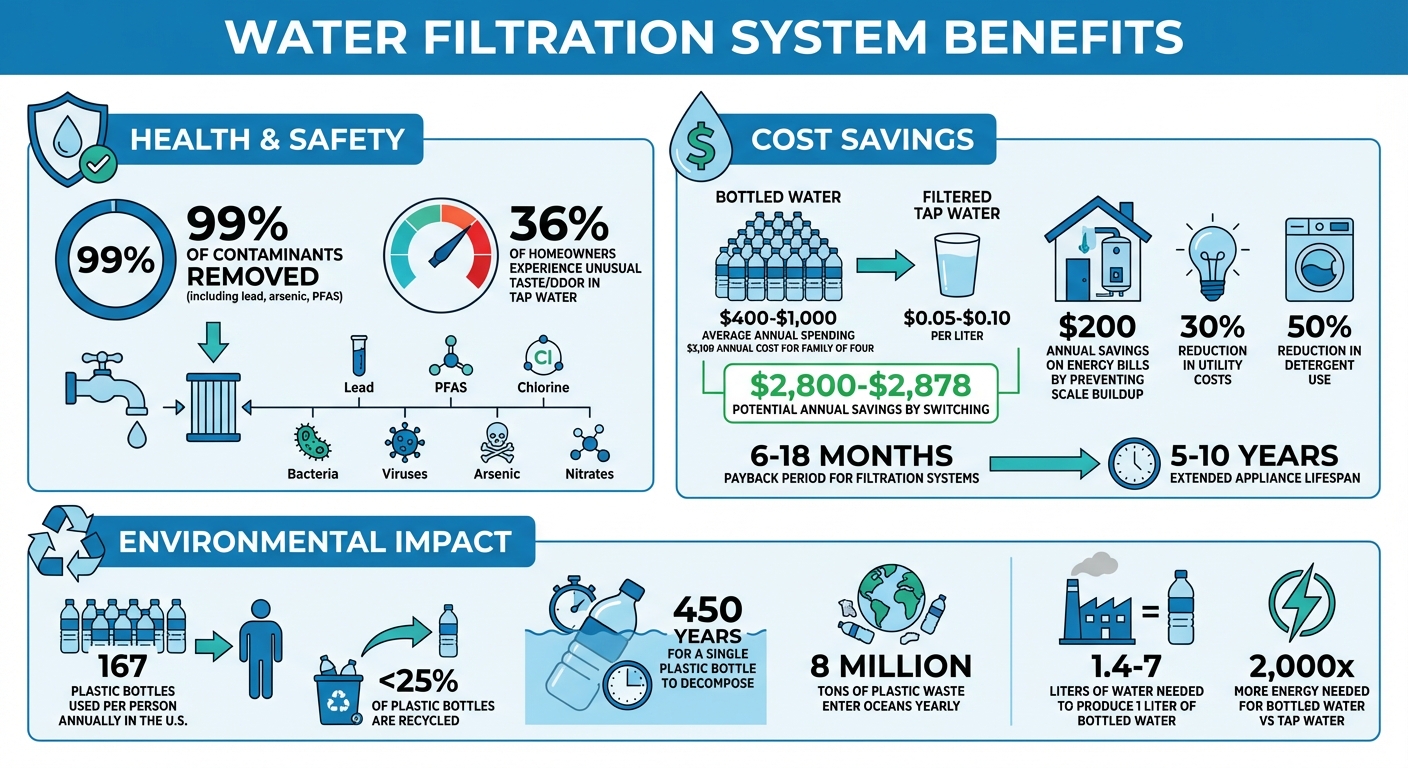
Water Filtration System Benefits: Cost Savings and Health Statistics
Benefits of Whole Home Water Filtration
sbb-itb-6ceaf48
1. Cleaner, Healthier Water Throughout Your Home
A whole-house water filtration system ensures that every faucet, shower, and appliance in your home delivers clean, filtered water. Unlike countertop pitchers or under-sink filters that only work at a single point, this system treats water right where the main line enters your home. That means your entire household benefits from consistently clean water, no matter where it's used.
These systems rely on multiple advanced filtration techniques to achieve this level of purity. Mechanical filters physically trap particles as tiny as 0.1 microns, which helps ensure your water looks clear. Activated carbon filters go a step further by using adsorption to capture chlorine, pesticides, and volatile organic compounds. For even finer filtration, reverse osmosis systems push water through semi-permeable membranes that block contaminants as small as 0.0001 microns, removing up to 99% of dissolved substances like heavy metals, including lead and arsenic. Additionally, UV sterilization employs specific wavelengths of light to neutralize bacteria, viruses, and parasites by damaging their DNA - achieving this without adding any chemicals.
With these methods working together, a whole-house water filtration system provides clean, healthy water for every need - from drinking and cooking to bathing, laundry, and even cleaning.
2. Better Taste and Odor
Does your tap water taste like a swimming pool or smell like rotten eggs? If so, you're not alone. Around 36% of homeowners deal with unusual tastes or odors in their water, ranging from chemical or metallic flavors to sulfur-like smells. Water filters tackle these specific contaminants head-on, improving both the taste and scent of your water almost instantly.
Activated carbon filters are a popular choice for removing chlorine, which is often the culprit behind that bleach-like flavor. For sulfur-related issues, specialized filtration media can neutralize hydrogen sulfide gas, eliminating those unpleasant rotten egg odors. On the other hand, reverse osmosis systems are designed to address dissolved salts and minerals, which are common contributors to bitter or metallic tastes, removing up to 99% of dissolved contaminants.
Cleaner water doesn’t just taste better - it enhances everyday life. Filtered water preserves the natural flavors of your drinks and meals. Even something as simple as ice cubes made with filtered water keeps that fresh, clean taste as they melt.
If you’re trying to choose the right filtration system, start by identifying the specific problem with your water. A strong "bleach" smell likely points to high chlorine levels, which carbon filters handle best. Meanwhile, a "rotten egg" odor suggests sulfur, requiring more targeted filtration solutions. Look for systems with NSF 42 certification, which guarantees independent testing to reduce taste and odor impurities. These upgrades not only improve water quality but also make daily household water use more enjoyable.
3. Better Health and Safety for Your Family
Clean water isn't just about taste - it’s about safeguarding your family’s well-being by removing harmful contaminants.
Unfiltered tap water can contain toxins that put your family’s health at risk. For instance, lead and copper from aging pipes can leach into the water, posing serious risks to children’s development and maternal health. On top of that, PFAS (per- and polyfluoroalkyl substances), often called "forever chemicals", have been linked to high cholesterol, liver issues, and even kidney or testicular cancer.
Biological contaminants are another concern. These include parasites like Giardia and Cryptosporidium, bacteria such as E. coli and Salmonella, and viruses like Norovirus or Hepatitis A. Exposure to these can lead to gastrointestinal issues, stomach pain, and diarrhea. Vulnerable groups - children, pregnant women, and those with weakened immune systems - are especially at risk.
"Lead in drinking water can cause serious health problems, especially for children and pregnant women." - CDC
Nitrates, often from fertilizers or septic systems, are particularly dangerous for infants under six months old, as they can interfere with oxygen transport in the blood. Other naturally occurring contaminants, such as arsenic and radon, also pose risks. Arsenic can cause symptoms like abnormal heart rhythms or tingling sensations, while radon released from water can contribute to lung cancer.
To combat these threats, a strong filtration system is essential. Whole-house filtration systems target contaminants at their source, while reverse osmosis systems can eliminate up to 99% of dissolved impurities, including lead, arsenic, and viruses. If PFAS removal is a priority, look for filters certified by NSF/ANSI 53 or 58. And if you rely on a private well, regular testing is critical - since the EPA doesn’t regulate private wells, the responsibility for identifying and addressing contaminants falls on you.
4. Longer-Lasting Plumbing and Appliances
Your home's plumbing and appliances can take a hit from unfiltered water. Hard water, loaded with minerals like calcium and magnesium, creates limescale that clogs pipes and damages appliances like water heaters and dishwashers. Over time, this buildup narrows pipes, restricts water flow, and forces appliances to work harder, driving up maintenance costs and reducing efficiency.
Keeping scale at bay does more than just protect your pipes - it also eases the workload on your appliances.
"Water purification systems, often seen as a luxury, actually serve as the unsung heroes of home maintenance, tackling wear before it can cause trouble." – Green Thumb Local, MNS Plumbing
Chlorine can also wreak havoc, breaking down rubber seals and gaskets in appliances, while sediment clogs water heater tanks and dishwasher spray arms. This forces appliances to consume more energy and shortens their lifespan.
Installing a filtration system can help avoid these problems. Reverse osmosis systems, for example, remove impurities that lead to scale buildup. By filtering out sediment and minerals at the water's entry point, these systems keep pipes clear, maintain steady water pressure, and extend the life of your appliances.
For the best protection, consider a whole-house filtration system installed at your main water shut-off valve - usually found in the garage, basement, or utility closet. Regularly replace filters every 2 to 6 months to ensure optimal performance.
5. Less Scale Buildup and Corrosion
Preventing scale buildup doesn’t just protect your appliances - it also helps safeguard your plumbing system from corrosion.
Scale forms when minerals like calcium and magnesium, common in hard water, stick to pipes, faucets, and fixtures. Hard water is typically measured at 7–10.5 grains per gallon (gpg), while anything above 10.5 gpg is considered very hard. These minerals leave behind white, crusty deposits that can narrow pipes, clog nozzles, and coat heating elements with an insulating layer.
Water filtration systems are designed to tackle this problem using different methods. Ion-exchange softening replaces calcium and magnesium ions with sodium or potassium ions. Reverse osmosis removes dissolved minerals and salts through a semipermeable membrane, cutting total dissolved solids by 85–99%. If you’re looking for a salt-free alternative, Template Assisted Crystallization (TAC) converts minerals into small crystals that remain suspended in water rather than sticking to surfaces.
By removing or neutralizing these minerals, filtration systems help prevent the corrosion that often accompanies scale buildup in plumbing and water heaters. This protects metal pipes and supports a more efficient water system. Additionally, chemicals like chlorine can speed up corrosion and cause pinhole leaks over time, making filtration even more important.
To choose the right system, start by testing your water to determine its hardness level. This will help you select a unit that’s properly sized for your needs. Installing a sediment pre-filter (5 microns or finer) ahead of your main filtration system can also help by trapping rust and silt that might otherwise clog the unit. Regular maintenance is key to keeping your system running smoothly.
6. Lower Costs and Utility Bills
Water filtration systems don’t just protect your plumbing and appliances - they can also lead to significant savings on household expenses.
One major area of savings is bottled water. U.S. households typically spend between $400 and $1,000 annually on bottled water, while a family of four may shell out more than $3,100 per year to stay hydrated. In comparison, filtered tap water costs only $0.05–$0.10 per liter, a fraction of the $1.00–$4.00 per liter price tag for bottled water. This means a family of four could save up to $2,800 to $2,878 each year by switching to filtered tap water.
Filtration systems also cut energy costs. Minerals in hard water create scale buildup on heating elements, forcing appliances like water heaters to work harder and consume more energy. This can add about $200 annually to your energy bills. By removing these minerals, filtration systems can reduce utility costs by up to 30%.
"Hard water minerals are the silent killers of your appliances, forcing them to work harder while driving up your energy bills." - Craig "The Water Guy" Phillips, Founder, SoftPro Water Systems
Filtered water also improves detergent performance, cutting detergent use by up to 50%. This reduces the need for extra cleaning supplies and additional rinse cycles, saving both money and energy. Over time, most filtration systems pay for themselves just through bottled water savings, often within 6 to 18 months. Initial costs range from $200 for under-sink systems to $1,000–$4,000 for whole-house units, with annual maintenance costs typically falling between $50 and $400.
The long-term benefits are just as compelling. By preventing scale buildup and corrosion, filtration systems can extend the lifespan of appliances like dishwashers, washing machines, and water heaters by 5 to 10 years, helping you avoid costly replacements that can exceed $1,000. These savings, combined with the health and maintenance perks, make filtration systems a smart investment.
7. Less Plastic Waste
Adding a home water filtration system can significantly reduce your reliance on disposable plastic water bottles. On average, people in the United States use about 167 plastic water bottles per year. Unfortunately, less than 25% of these are recycled, meaning the majority end up in landfills or polluting oceans. To make matters worse, a single plastic bottle can take roughly 450 years to decompose.
The environmental toll doesn’t stop there. Producing bottled water is incredibly resource-heavy, requiring anywhere from 1.4 to 7 liters of water to create just one liter of bottled water. Plus, the energy needed for production is up to 2,000 times greater than what’s needed for tap water. This inefficiency contributes to the staggering 8 million tons of plastic waste that enter the oceans every year.
Here’s a stark reminder from the experts:
"Nearly 80% of plastic water bottles end up in landfills or the ocean."
- CPI Plumbing, Heating, Cooling & Electrical
By using a filtration system alongside reusable bottles made of stainless steel or glass, you can prevent thousands of plastic bottles from being tossed out over the system's lifespan. Modern systems, like reverse osmosis or carbon filters, deliver water quality that matches or even surpasses bottled water, improving both taste and sustainability. This simple switch not only supports the environment but also helps reduce household expenses.
With filtration systems ranging in price from about $30 to $1,500 upfront, this investment benefits both your budget and the planet for years to come.
How Sasquatch Plumbing Services Seattle Can Help
Professional installation plays a big role in getting the most out of your water filtration system.
Sasquatch Plumbing Services Seattle specializes in installing water filtration systems across West Seattle, addressing common problems like chlorine taste and sediment buildup from older pipes. While Seattle’s tap water originates from the protected Cedar and Tolt River Watersheds, homes with aging plumbing may still face issues like lead or rust particles even after municipal treatment.
Our licensed plumbers ensure seamless integration of filtration systems into your existing plumbing, always adhering to local codes. Whether you’re looking at an under-sink reverse osmosis system or a whole-house setup to prevent mineral buildup in appliances, proper installation is key to maintaining both water flow and the system’s efficiency.
We kick things off with a water quality assessment to identify specific contaminants in your home’s supply. This helps you select an NSF-certified system that addresses concerns like lead, hard water, or chlorine taste. For homes dealing with high sediment levels or hard water, a whole-house filtration system not only improves water quality but also benefits your skin, hair, and laundry.
To make things even better, we provide upfront pricing for all installations, so there are no surprises. Plus, every job is backed by a satisfaction guarantee, ensuring long-lasting results. From water quality assessments to same-day emergency repairs, we’re proud to serve all neighborhoods in West Seattle with prompt and dependable service.
Conclusion
Installing a water filtration system offers solid protection for your family's health while helping to preserve your plumbing and appliances. These systems can remove up to 99% of contaminants, including lead and chlorine, ensuring cleaner, safer water for your household. Plus, they can save the average family over $500 per year by reducing reliance on bottled water. The advantages touch nearly every aspect of your home, from improved water quality to safeguarding your infrastructure.
But it’s not just about saving money. With a filtration system, you’ll enjoy better-tasting water, healthier skin and hair, and the satisfaction of reducing plastic waste - all while keeping appliances running smoothly.
As RWI Water Systems highlights:
"A home water filtration system is more than just a convenience. It's a smart investment in your family's health and comfort."
For the best results, professional installation ensures seamless integration with your plumbing, maintains proper water pressure, and adheres to local regulations. Starting with a water quality test is a smart step - it helps pinpoint the specific contaminants in your water so you can pick the right filtration system for your needs.
The right system doesn’t just protect your health - it also lowers long-term maintenance costs and enhances daily life.
FAQs
Which water filter system is best for my home’s water issues?
When it comes to choosing the best water filtration system, the right option depends on the specific contaminants in your water. If you're dealing with common problems like chlorine, heavy metals, or bacteria, point-of-use systems, such as reverse osmosis, are a solid choice. On the other hand, if you’re looking to address issues throughout your entire home, a whole-house filtration system can tackle things like chlorine, sediments, and minerals.
To make the best decision, a professional water test is key to identifying what’s in your water. For personalized guidance, Sasquatch Plumbing Services Seattle can help you select a system that ensures your water is clean and safe.
Do I need a water test before choosing a filtration system?
Testing your water before picking a filtration system is a smart move. It helps pinpoint the exact contaminants or issues affecting your water quality. By identifying these problems upfront, you can select a system that targets those specific concerns, ensuring it works effectively. This simple step can make all the difference in providing cleaner, safer water for your home.
How often do filters need to be replaced and what does maintenance cost?
Water filters usually need to be replaced anywhere from every 3 to 12 months. This depends on factors like the type of filter and how much it’s used. The cost for maintenance can vary quite a bit, typically falling between $20 and $200 per filter. Keeping up with regular replacements is key to maintaining both high water quality and the efficiency of the filtration system.